
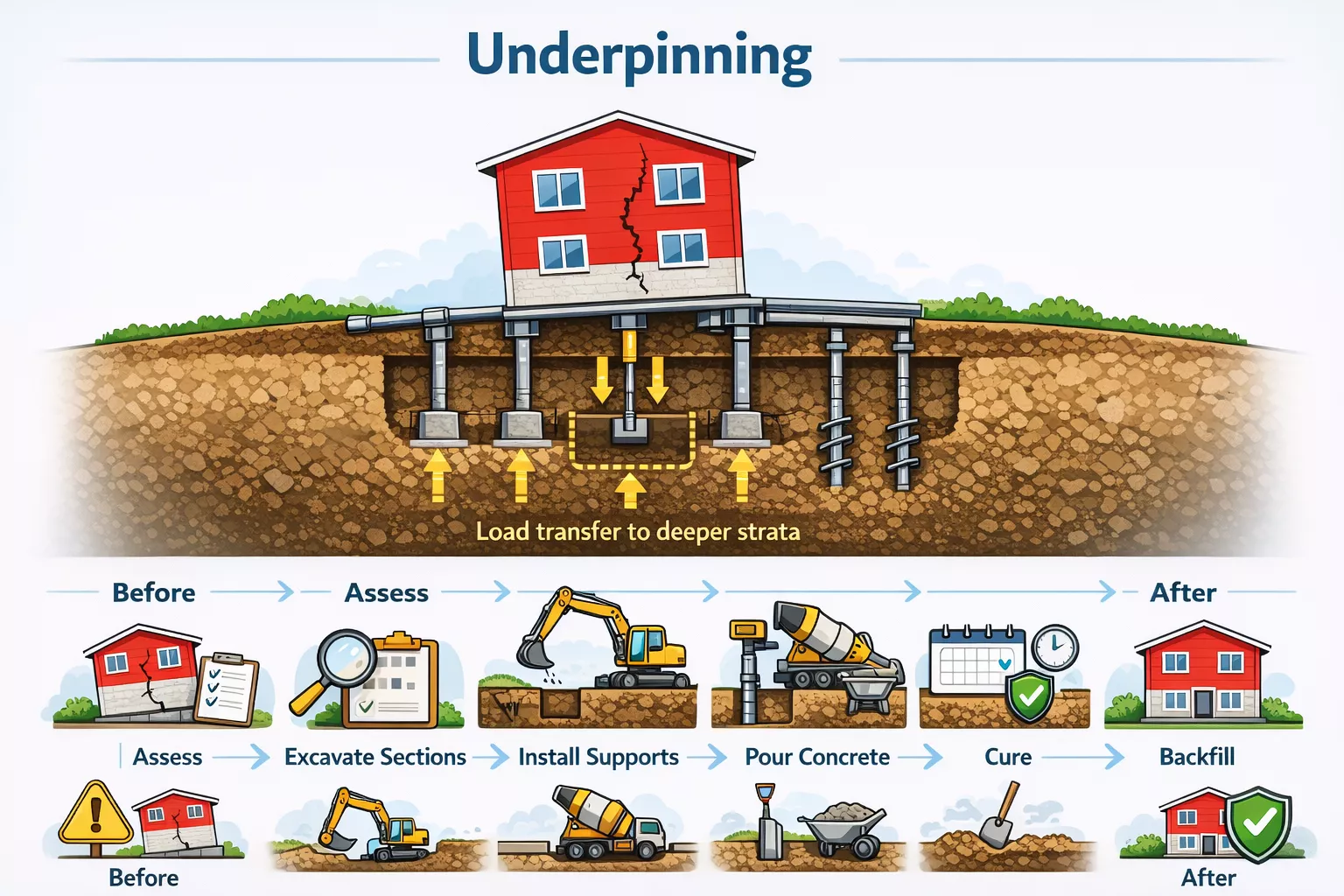
Underpinning is the process of strengthening and repairing the foundation of an existing building by extending foundation depth or increasing load-bearing capacity so structural loads transfer to stronger, more stable soil layers. Underpinning in construction adds engineered support beneath existing footings to stabilise settlement, restore foundation performance, and maintain structural safety. The purpose of underpinning centres on structural stabilisation, increasing load capacity for additions or heavier loads, repairing foundation-related damage, protecting structures affected by nearby excavation, and correcting design or construction defects that reduce foundation performance.
Buildings require underpinning when the existing foundation loses adequate support due to foundation movement or subsidence, shallow or weak foundations, environmental changes that alter soil behaviour, or excavation and nearby construction that disturbs bearing soils. Signs a property may need underpinning include worsening cracks in walls or ceilings, uneven or sloping floors, visible foundation cracks or separation, sticking doors or windows, water seepage linked to drainage issues, sagging floors above the basement, and repeated repairs that fail to hold. The main underpinning methods include mass concrete underpinning (pit method), beam-and-base underpinning, mini-piled or micropiled underpinning, resin or grout injection, cantilever or Pynford stool methods, and screw pile or helical pile underpinning, each selected to match soil conditions, site access, and structural load requirements.
Underpinning follows an engineered workflow that includes assessment and preparation, controlled excavation where required, installation of permanent supports, and completion steps that confirm stable load transfer. Costs typically range from $50 to $500 per square foot and $300 to $600 per linear foot, with soil conditions, depth, method choice, and access driving totals. Benefits include improved structural integrity, increased basement headroom where lowering occurs, improved property condition and value, foundation reinforcement for expansion, and opportunities for waterproofing and drainage upgrades. Risks and challenges include temporary loss of support during excavation, differential movement and cracking, variable bearing strata, groundwater issues, party wall constraints, utility conflicts, restricted access, workmanship sensitivity, and permit and inspection requirements, which is why professional, permit-compliant underpinning contractors and engineering oversight remain central to safe outcomes.
What Is Underpinning?
Underpinning is the process of strengthening and repairing the foundation of an existing building or structure by extending the foundation depth or increasing its load-bearing capacity so structural loads transfer to stronger and more stable soil layers. Engineers use underpinning when the original foundation loses structural stability or lacks sufficient bearing capacity to support the building. Construction teams install additional structural supports beneath the existing footing to stabilise settlement, restore foundation performance and maintain structural safety.
Common underpinning materials include mass concrete, reinforced beam and base systems and micropiles. Mass concrete underpinning forms new concrete blocks beneath existing foundations to increase the bearing area. Beam and base underpinning uses reinforced concrete beams that transfer structural loads across newly constructed bases. Micropiles consist of small-diameter steel-reinforced piles drilled deep into competent soil or bedrock to provide deep foundation support.
What is underpinning in construction?
Underpinning in construction is the process of strengthening and repairing an existing building foundation by extending the foundation depth or increasing its load-bearing capacity to reach stronger and more stable soil layers. The method stabilises a structure when the original foundation no longer supports structural loads effectively. Engineers install additional structural support beneath the existing footing so building loads transfer safely to competent ground. Common underpinning materials include mass concrete, reinforced beam and base systems and micropiles. Mass concrete underpinning forms new concrete blocks beneath existing footings to provide additional bearing area. Beam and base underpinning uses reinforced concrete beams that distribute loads across new concrete bases. Micropiles consist of steel-reinforced small-diameter piles drilled deep into stable strata to provide deep foundation support.
Several structural conditions require underpinning. Foundation failure occurs when soil settlement, erosion or inadequate original construction weakens the existing foundation. Structural changes arise when buildings receive additional floors or heavier structural loads that exceed the original design capacity. Construction changes occur during nearby excavation, basement lowering or adjacent development that alters soil stability around the structure. Upgrading improves older foundations so the structure meets modern engineering standards and increased load requirements. Underpinning restores structural stability, strengthens the existing foundation system and ensures safe load transfer from the building to stable ground.
What is the Purpose of Underpinning?
The purpose of underpinning is to strengthen and stabilise the existing foundation of a structure so that the building safely transfers loads to stable soil layers. Underpinning strengthens and stabilises foundations that experience settlement, structural damage or inadequate load capacity. The method reinforces the structural base of a building by installing additional support beneath the existing foundation, which restores stability and improves long-term structural performance.
Key Purposes of Underpinning:
- Structural Stabilisation: Underpinning strengthens and stabilises a building when soil movement, settlement or weakened ground conditions reduce the stability of the existing foundation.
- Increasing Load Capacity: Underpinning increases the load-bearing capacity of the existing foundation when a building receives structural additions such as extra floors, heavier structural components or extensions.
- Repairing Damage: Underpinning strengthens and stabilises foundations that show cracks, settlement or structural deterioration.
- Protection from Nearby Excavation: Underpinning protects structures when nearby excavation, basement construction or adjacent development alters surrounding soil conditions.
- Correcting Faulty Design: Underpinning strengthens and stabilises foundations built with inadequate depth, poor soil assessment or insufficient load calculations.
Underpinning therefore serves a critical role in construction by reinforcing the existing foundation, improving structural stability, increasing load capacity and protecting buildings from structural movement or foundation failure.
How Underpinning Strengthens Foundations?
The purpose of underpinning is to strengthen and stabilise an existing building foundation by installing additional structural support beneath the existing foundation so building loads transfer to stronger and more stable soil layers. Underpinning restores structural stability when the original foundation lacks adequate load-bearing capacity, experiences settlemen or requires reinforcement due to structural modifications. Construction teams extend or reinforce the foundation system using specialised techniques such as concrete underpinning, piling systems or ground stabilisation methods. Engineering assessments determine the appropriate technique based on soil conditions, structural load requirements and project scope. Project scope and soil conditions strongly influence the basement underpinning cost, particularly in projects involving basement lowering or foundation depth extension.
Here is the key step on how different underpinning methods strengthen foundations:
- Mass Concrete Underpinning (Pit Method): Mass concrete underpinning, often called concrete underpinning, strengthens foundations by excavating small sections beneath the existing foundation and filling each section with reinforced or mass concrete.
- Mini-Piled Underpinning: Mini-piled underpinning uses small-diameter steel-reinforced piles drilled deep into stable soil or bedrock.
- Beam and Base Underpinning: Beam and base underpinning installs reinforced concrete beams beneath the existing foundation that distribute structural loads across newly constructed concrete bases.
- Resin Injection Underpinning: Resin injection underpinning strengthens ground conditions by injecting expanding structural resin into weak or compressible soil beneath the existing foundation.
Each underpinning method strengthens foundations by reinforcing structural support beneath the existing foundation, improving load distribution, stabilising soil conditions and preventing further settlement or structural movement. Selection of the appropriate method depends on structural requirements, soil composition and construction constraints.
Why Buildings Require Underpinning?
Buildings require underpinning because the existing foundation no longer provides adequate support for the structure. Underpinning is the process of installing additional structural support beneath the existing foundation to strengthen the foundation, increase load-bearing capacity and restore long-term stability by transferring loads to stronger soil or deeper bearing strata.
Key Requirements for Underpinning Buildings:
- Foundation Movement or Subsidence: Ground settlement, soil shrinkage, erosion or void formation causes the existing foundation to move, leading to cracking, uneven floors and structural distortion.
- Increased Structural Load: Added storeys, extensions, heavier finishes or changes in occupancy loads increase demand on the foundation beyond its original design capacity, requiring underpinning to strengthen the foundation system.
- Shallow or Weak Foundations: Foundations built at insufficient depth or placed on low-bearing soils lack structural support, creating ongoing settlement risk and reduced long-term stability.
- Environmental Factors: Seasonal moisture changes, freeze–thaw cycles, drainage failures and tree root moisture extraction alter soil volume and bearing capacity, increasing foundation movement and structural stress.
- Excavation and Nearby Construction: Adjacent excavation, basement lowering or nearby construction activities reduce lateral soil support or disturb bearing soils, increasing movement risk beneath the existing foundation and triggering the need to strengthen the foundation.
Why do buildings need underpinning after foundation movement or settlement?
Foundation movement or settlement creates uneven support in the soil beneath a building’s foundation, which reduces bearing capacity and shifts structural loads into walls, slabs and framing. Underpinning addresses this condition by installing engineered support beneath the building’s foundation to reach competent soil layers or to spread loads across a stronger base, which achieves strengthening and stabilizing foundations. Environmental changes such as prolonged wetting, drought-driven shrinkage, freeze–thaw cycling and drainage failures alter soil volume and stiffness, which increases differential movement. Increased structural loads from additions, basement renovations or heavier finishes raise foundation pressures, which intensifies settlement in weak or compressible soil. Underpinning restores level support, reduces ongoing movement and protects long-term stability by re-establishing reliable load transfer into stable ground.
Why is underpinning needed when a building’s loads increase?
A building needs underpinning after loads increase because the original foundation system no longer provides the load-bearing capacity of the structure’s updated design loads. Underpinning in construction refers to strengthening an existing foundation by adding support beneath the footing system so building loads transfer through a stronger structural path into competent ground. A structural engineer evaluates load changes, soil conditions and foundation performance, then specifies an underpinning method that restores foundation capacity and reduces settlement risk.
Key reasons underpinning is necessary for increased loads include:
- Increasing Load-Bearing Capacity: Underpinning increases the load-bearing capacity of the existing foundation by enlarging the effective footing area or adding new structural elements that carry higher loads.
- Transferring Loads to Deeper Soil: Underpinning transfers loads to deeper soil strata with higher bearing strength through deep elements such as piles or micropiles connected to the foundation.
- Preventing Settlement: Underpinning reduces foundation pressure on weak soil and improves load distribution, which limits further differential settlement and structural distortion.
- Providing Structural Integrity: Underpinning stabilises the foundation system, reduces cracking and movement and preserves structural alignment under increased loading.
Increased loads place higher stress on soil and existing foundations. Underpinning restores structural safety by increasing foundation capacity, improving load transfer into stable groun and maintaining foundation performance under the building’s updated load demands.
Why can nearby excavation or construction force underpinning?
Nearby excavation or construction can force underpinning because excavation changes the ground conditions that support a structure, which reduces the stability of soil around and beneath the existing foundation. Underpinning is used to strengthen and stabilise existing foundations when excavation and structural works remove lateral soil restraint, reduce bearing support or trigger settlement. Concrete underpinning is a common solution when engineers need to place new load-bearing support under an existing footing to restore safe load transfer and limit movement.
Here are the specific reasons why this happens:
- Loss of Soil Support (Subsidence): Excavation removes soil that previously supported the ground around beneath the existing foundation, which increases settlement risk and can trigger subsidence as soil shifts toward the excavation.
- Soil Movement and Vibration: Construction vibration from piling, compaction and heavy equipment disrupts soil structure and reduces soil stiffness, which increases differential movement and undermines foundation support.
- Water Table Changes: Dewatering and drainage changes lower or redirect groundwater, which alters soil strength and volume, increasing settlement risk in compressible soils and reducing long-term stability.
- Deepening Adjacent Foundations: Excavating deeper foundations next to an older structure changes the stress distribution in the soil and can undercut bearing soils, creating a need to support and strengthen and stabilise existing foundations to prevent movement.
Excavation and structural activity alters soil support and groundwater behaviour around a building, which increases settlement and movement risk. Underpinning restores structural safety by adding engineered support beneath the existing foundation, protecting the building from further movement triggered by adjacent construction.
Why do changes in soil conditions cause underpinning?
Changes in soil conditions cause underpinning because the soil that supports a foundation changes in strength, volume or density, which reduces bearing support and triggers settlement or movement. Underpinning re-establishes reliable support by transferring structural loads to stable ground layers or by increasing foundation capacity so the structure maintains long-term stability across different soil types. The success of underpinning depends on proper planning and expert assessment of the soil type, structural loads and site constraints, since soil can be highly variable across a single property and behaves differently in clay, sand, fill and in rocky soil.
Here are the specific ways changes in soil conditions lead to the need for underpinning:
- Soil Shrinkage and Expansion (Reactive Soils): Reactive clay soils expand when moisture increases and shrink when moisture decreases.
- Soil Erosion and Washout: Water flow from poor drainage, leaking services or surface runoff washes fine soil particles away.
- Changes in Soil Density (Poorly Compacted Fill): Poorly compacted fill compresses over time under structural loads.
- Organic Activity (Tree Roots and Vegetation): Tree roots extract moisture from clay soils, increasing shrinkage near the foundation.
- Nearby Construction or Excavation: Excavation changes soil stress conditions and removes lateral support, while vibration and dewatering alter soil structure and groundwater levels.
Soil conditions drive underpinning needs because a foundation performs as a soil–structure system, not as a standalone concrete element. Accurate identification of the soil type, geotechnical testing and engineered design control the success of underpinning across different soil types and site conditions.
Why is underpinning used to fix design or construction defects?
Underpinning is an engineered foundation strengthening process used to fix design or construction defects that reduce the load-bearing performance of a building’s foundation system. Design defects include inadequate footing width or depth, incorrect bearing assumptions or omission of support where soil conditions require deeper foundations. Construction defects include poor concrete quality, improper reinforcement placement, weak compaction beneath footings or inconsistent foundation levels that create uneven load transfer. Underpinning addresses these defects by installing new structural elements that provide additional support for the foundation and restore the structural integrity of the building by creating a reliable load path into stable ground. Underpinning is an effective corrective measure to stabilize a structure when the original foundation design or workmanship fails to meet structural demands or long-term performance requirements.
Why do older buildings often need underpinning?
Older buildings need underpinning when original foundations no longer match current soil and load conditions, reducing the structural integrity of the building. Underpinning is an engineering method that provide additional support for existing footings by extending foundation depth or bearing area, which helps to stabilize a structure and restore load transfer into competent soil. Age-related mortar and concrete deterioration, repeated freeze–thaw cycles, long-term drainage problems and historic shallow footing designs increase settlement and cracking risk, particularly in clay or poorly compacted fill. Modern renovations and load upgrades add structural demand that older foundation systems were not built to carry, making underpinning a direct corrective measure for foundation performance and long-term stability.
What are the signs a property may need underpinning?
A property may need underpinning when the foundation system shows signs of movement or loss of bearing support that affect structural performance. Underpinning is the process of strengthening an existing foundation by adding engineered support beneath it to transfer loads to stable soil and reduce ongoing settlement. A home might need underpinning when ground movement creates progressive structural distortion and existing repairs fail to stop recurrence, since underpinning is designed to provide a permanent fix by restoring a stable load path.
Here are the key signs that a property may need underpinning include:
- Cracks in Walls or Ceilings: Diagonal cracks near doors and windows, widening cracks or repeated patch failures indicate ongoing ground movement affecting structural alignment.
- Uneven or Sloping Floors: Floor levels that tilt, dip or feel bouncy indicate differential settlement and uneven foundation support.
- Visible Foundation Cracks or Separation: Cracks in foundation walls, separation at joints or gaps between foundation sections indicate structural stress or movement at the base of the building.
- Sticking Doors or Windows: Doors that jam, windows that bind and misaligned frames indicate shifting openings due to foundation movement.
- Water Seepage or Drainage Issues: Persistent moisture, pooling near the foundation or seepage through walls indicates drainage problems that weaken soil support and increase settlement risk.
- Sagging Floors Above the Basement: Sagging or deflection in floor framing above the basement indicates shifting supports, settlement or compromised load transfer to the foundation.
- Previous Foundation Repairs That Didn’t Hold: Recurring cracks after cosmetic repairs or repeated re-levelling indicates underlying soil and foundation instability that requires a structural solution.
A home might need underpinning when multiple signs occur together or worsen over time, since combined symptoms typically reflect ground movement affecting the foundation system. Structural assessment confirms the cause and determines whether underpinning provides a permanent fix for foundation stability.
Are there cracks in walls that are getting worse over time?
Yes, cracks in walls that are getting wider, longer or appearing in new areas indicate expanding cracks caused by ongoing movement in the structure or its foundation support. A worsening wall crack is a crack that shows measurable change over time in width, length or pattern, including cracks that reopen after filling or repainting. Hairline cracks often remain stable and superficial, especially in plaster, drywall joints or new finishes, while expanding cracks typically show progressive separation, stepped cracking in masonry, diagonal cracking around doors or windows or widening gaps that return after repair.
Are doors and windows sticking or no longer fitting properly?
Yes, sticking doors and windows that no longer open, close, latch or sit square in the frame indicate a fit problem caused by structural movement. A sticking door or window is an opening that binds, scrapes, jams or shows uneven gaps because the building frame settles, sinks or shifts, which distorts the shape of the opening and changes alignment between the sash or door slab and its frame.
Are floors becoming uneven, sloping, or bouncy?
Yes, uneven, sloping or bouncy floors are common signs of a support or foundation issue that affects floor level and stiffness. An uneven, sloping or bouncy floor is a floor surface that changes height across a room, tilts toward one side or flexes under normal foot traffic because structural supports shift, weaken or lose bearing capacity. Common causes of uneven floors include settlement in foundation footings, movement in basement walls, undersized or deteriorated joists or sagging beams, which advanced basement systems address through engineered structural reinforcement. Methods used to fix uneven floors include levelling and stabilising the supporting structure with reinforced beams, posts, jacking systems or foundation repair solutions matched to the cause.
What are the main types of underpinning methods?
The main types of underpinning methods are foundation strengthening techniques that install new support under the foundations and transfer building loads to stable ground. Underpinning is the process of reinforcing an existing foundation by adding structural elements made from concrete or steel so the foundation achieves stable load transfer and reduced settlement risk. Different types of underpinning suit different soil conditions, access constraints and structural load requirements, which is why multiple methods of underpinning exist within modern construction.
Here are the main key types of underpinning methods:
- Mass Concrete Underpinning (Pit Method): Concrete underpinning that excavates short sections under the foundations and fills each section with mass or reinforced concrete to increase bearing area and improve stability.
- Mini-Piled Underpinning: Small-diameter piles, typically concrete or steel, drilled or driven to deeper load-bearing strata and connected to the foundation through reinforced caps or beams.
- Beam and Base Underpinning: Reinforced concrete beams installed under the foundations and supported on new concrete bases that spread loads to stable ground while limiting differential settlement.
- Resin Injection Underpinning: Structural resin injected into weak soil under the foundations and expanded to fill voids, densify ground and lift minor settlement where suitable ground conditions exist.
- Cantilever/Pynford Stool Method: A staged underpinning approach that uses needle beams and brackets to support walls and transfer loads to newly constructed bases where access and sequencing require localised support.
- Screw Pile/Helical Pile Underpinning: Helical piles made from steel shafts with helical plates installed by torque into stable layers and used to support foundations through steel brackets or concrete caps.
These different types of underpinning provide targeted foundation support by using concrete or steel elements placed under the foundations and engineered to match soil behaviour, structural loading and site constraints.
What is mass concrete underpinning?
Mass concrete underpinning (or the “pit method”) is a foundation strengthening technique that supports an existing building by excavating small, controlled sections beneath the existing foundation and filling each excavation with mass concrete to form new load-bearing blocks. The method increases the effective bearing area of the foundation and transfers structural loads to stronger soil at a lower level. Construction proceeds in a sequenced pattern so the structure remains supported while each concrete underpinning pit cures and becomes part of the enlarged foundation system.
What is beam-and-base underpinning?
Beam-and-base underpinning is an advanced foundation repair method that strengthens an existing foundation by installing a reinforced concrete beam that collects structural loads from the wall or footing and transfers those loads onto a series of new concrete bases formed in stable ground. Contractors excavate sequenced pits beneath the foundation line, pour mass or reinforced concrete bases at set intervals, then cast the reinforced beam to span between bases and create a continuous load path. The system improves long-term stability by distributing loads across multiple bearing points and reducing differential settlement in variable ground conditions. Structural engineers specify base sizing, beam reinforcement and construction sequencing to maintain structural integrity during installation.
What is mini-piled (piled) underpinning?
Mini-piled (or micropiled) underpinning is a foundation strengthening method that supports an existing structure by installing small-diameter, deep piles through weak ground into competent soil or bedrock and then connecting those piles to the building’s foundation with reinforced concrete caps or beams. The piles act as load-transfer elements that carry structural loads away from shallow, compressible soils and into deeper stable strata. Mini-piled underpinning suits restricted-access sites and foundations that require deeper support due to settlement, weak bearing soils or increased structural loads.
What is needle beam underpinning?
Needle beam underpinning is a structural repair method that strengthens an existing foundation by inserting steel or reinforced concrete “needle” beams through or beneath load-bearing walls to temporarily support the structure while new permanent foundation supports are constructed below. The needle beams transfer building loads to temporary supports, such as hydraulic jacks and kentledge or props, so contractors can excavate and install new underpinning bases or deeper supports without uncontrolled settlement. Structural engineers specify beam sizing, support spacing and installation sequence to maintain structural stability during foundation repair.
What is cantilever underpinning?
Cantilever underpinning is a specialized foundation strengthening method that supports an existing wall or foundation by constructing new underpinning bases beside or beneath the footing and using a reinforced concrete beam that projects from the new support to carry the load of the existing foundation in a cantilever action. The method transfers structural loads from the original footing to newly formed bearing points when direct access beneath the foundation is restricted or when excavation needs staged support. Structural engineers design the cantilever beam and base dimensions so load transfer remains stable and settlement risk is controlled during and after installation.
What is grout injection underpinning?
Grout injection underpinning is a non-disruptive, cost-effective foundation repair method that stabilises a structure by injecting cementitious grout into weak or voided ground beneath the foundation to fill gaps, densify the soil and improve bearing support. The injected grout spreads through fissures and low-density zones, increases ground stiffness and reduces settlement by restoring contact between the foundation and the supporting ground. Contractors use controlled injection pressures and staged placement to target specific settlement areas and limit unintended ground heave.
What is resin injection underpinning?
Resin injection underpinning is a fast, non-invasive method to stabilise and re-level foundations by injecting expanding structural resin beneath the foundation to fill voids, densify weak soil and increase bearing support. The resin expands after injection, compresses loose ground and restores contact between the foundation and the supporting soil, which reduces settlement and improves structural stability. Contractors deliver the resin through small drilled access points and monitor lift and ground response to control expansion and limit over-lifting.
What is screw pile (helical pile) underpinning?
Screw pile (helical pile) underpinning is a fast, low-impact method for strengthening an existing foundation by installing steel piles with helical plates into load-bearing soil layers and connecting them to the foundation with steel brackets or reinforced concrete caps. Installation uses hydraulic torque to advance each pile to a specified depth and resistance level, creating a deep load path that transfers structural loads away from weak near-surface soil. Helical pile underpinning limits excavation, supports restricted-access sites and provides immediate foundation support once piles and connections reach the designed capacity.
How do you choose the right underpinning method?
Choosing the right underpinning method depends on a structural assessment that matches the failure mechanism, ground behaviour and load path requirements to a specific foundation strengthening technique. Selecting an underpinning approach is the engineering decision that determines which of the types of underpinning methods delivers reliable load transfer under the foundations while restoring structural stability and limiting further movement.
Here is a breakdown of how to choose the right underpinning method:
- Soil Conditions: Reactive clay, loose granular soils, poorly compacted fill and rock each require different load-transfer solutions. Mini-piled underpinning and screw piles suit weak or variable strata by transferring loads to deeper competent layers, while mass concrete underpinning suits shallow competent ground where increased bearing area resolves settlement.
- Cause of Subsidence: Soil shrink–swell, erosion, leaking drains and loss of bearing demand different interventions. Resin or grout injection targets voids and localised loss of density, while beam-and-base or piling systems address ongoing settlement linked to inadequate bearing depth.
- Site Accessibility: Restricted access, party walls, limited headroom and tight property lines influence equipment choice and construction sequencing. Mini-piles, micropiles and helical piles fit confined sites, while mass concrete underpinning requires excavation access along the foundation line.
- Structural Load: Higher building loads and concentrated point loads require higher-capacity underpinning elements and stronger connections to the existing foundation. Beam-and-base systems distribute loads along a reinforced beam, while piled underpinning transfers loads through designed caps or beams into deep bearing strata.
- Budget and Time: Project cost and programme length influence method selection through excavation volume, temporary works, curing time and equipment requirements. Mass concrete underpinning often involves longer curing and staged excavation, while helical piles and resin injection typically reduce excavation and accelerate installation where site conditions align.
Method selection links soil behaviour, subsidence cause, access constraints and structural loading to a designed load-transfer system under the foundations. A structural engineer confirms the most suitable option through site inspection, crack and level monitoring and geotechnical data that define bearing capacity and settlement risk.
What Is the Underpinning Construction Process?
Underpinning is a structural repair process used in underpinning in construction to strengthen and stabilise an existing building foundation by adding engineered support below the foundation so loads transfer to stable ground. Is underpinning in construction necessary when settlement, subsidence, load increases or adjacent excavation reduce foundation performance. Professionals for underpinning design and install a method that matches soil behaviour, structural loads and site constraints to achieve the best underpinning process for long-term stability.
Key Aspects of the Underpinning Construction Process:
- Purpose: Underpinning restores foundation performance by increasing load-bearing capacity, controlling settlement and re-establishing a stable load path into competent soil or rock.
- Methodology: Method selection defines how loads transfer and how ground support improves. The best underpinning process depends on soil conditions, access constraints and structural demand.
- Mass Concrete: Excavation proceeds in staged pits beneath the existing footing, then concrete is poured to form new bearing blocks that increase footing area and depth.
- Beam and Base: New concrete bases are constructed at intervals, then a reinforced concrete beam spans between bases to collect and distribute wall loads across multiple bearing points.
- Mini-piled: Small-diameter piles are drilled into deeper stable strata, then connected to the structure using reinforced concrete caps or beams that transfer loads into the piles.
- Resin Injection: Expanding structural resin is injected beneath the foundation to fill voids, densify weak soils and stabilise minor settlement by restoring ground contact.
- Procedure Steps: Site investigation and engineering design confirm soil profile, bearing capacity and movement mechanism.
Underpinning in construction follows a defined repair workflow that links purpose, method selection and controlled installation steps. Professionals for underpinning ensure the process strengthens the foundation system without causing additional movement during excavation, piling or injection activities.
How Does the Underpinning Construction Process Work?
Underpinning is the process of strengthening and stabilising an existing foundation by adding engineered support beneath the foundation so building loads transfer to stable ground and settlement risk reduces. The underpinning construction process works through controlled assessment, staged groundwork, installation of permanent support elements and structural completion steps that maintain stability throughout the repair.
Here are the key aspects of the Underpinning Construction Work Process:
- Engineering and Preparation: Structural and geotechnical assessment identifies the cause of movement, the soil profile and the required foundation capacity.
- Excavation (Pit Method): Staged excavation creates small pits beneath the foundation line in a sequenced pattern so the building remains supported.
- Installation of Support: Permanent support is installed according to the selected method, such as pouring mass concrete in pits, forming beam-and-base elements, installing mini-piles with caps or injecting stabilising material beneath the foundation.
- Fixing and Finishing: Structural checks confirm stable load transfer and controlled movement.
The underpinning construction work process therefore follows an engineered sequence that protects the structure during excavation and support installation, then locks in long-term stability through permanent foundation reinforcement.
How Is Underpinning Carried Out in Construction?
Underpinning is a critical, labor-intensive construction technique used to strengthen the existing foundation of a structure by installing engineered support beneath it so building loads transfer as loads to stable soil or competent bearing strata. Underpinning in construction is carried out through structural and geotechnical assessment, controlled groundworks and staged installation of permanent supports integrated with existing building systems such as basement slabs, load-bearing walls and drainage interfaces. Contractors complete the work in sequenced sections to maintain stability while new support elements cure, lock in load transfer and limit further settlement.
Key Aspects of Underpinning Carried Out in Construction:
- Mass Concrete (Pit Method): Contractors excavate small pits beneath the existing foundation in a sequenced pattern and pour mass concrete to form new bearing blocks. Each block increases bearing area and transfers structural loads to stable soil at a lower level.
- Beam and Base Method: Construction teams form concrete bases at set intervals below the foundation line, then cast a reinforced concrete beam that spans between bases. The beam collects wall loads and distributes them across multiple bases for improved long-term stability.
- Mini-Piled Underpinning: Installers drill small-diameter piles through weak ground into competent strata and connect piles to the foundation with reinforced caps or beams. The pile system transfers loads to stable soil at depth when shallow soils lack bearing strength.
- Resin Injection/Grout Injection: Technicians inject expanding resin or cementitious grout beneath the existing foundation to fill voids and increase ground stiffness. Injection treatment improves soil support and restores contact between the foundation and supporting ground where loss of density drives settlement.
How Much Does Underpinning Cost?
Underpinning costs typically range from $50 to $500 per square foot and $300 to $600 per linear foot, with published pricing guides showing $50–$100 per square foot for some underpinning scopes and $300–$500 per square foot for basement lowering and underpinning scopes , plus $300–$600 per linear foot for underpinning sections along foundation walls. Underpinning is a foundation repair process that strengthens and stabilises an existing structure by adding engineered support beneath the foundation so loads transfer into stable ground. Soil conditions, depth of underpinning, chosen method, site access and engineering requirements drive the final price range for a specific project.
What Is the Average Cost of Underpinning a House?
Underpinning a house typically costs between $10,000 and $25,000, with pricing commonly expressed as $300 to $600 per linear foot for underpinning sections along foundation walls or $50 to $100 per square foot for area-based scopes. The average cost of underpinning a house is the estimated total price to strengthen and stabilise an existing foundation by adding engineered support beneath it so structural loads transfer into stable soil. Project totals reflect the underpinning length or area, required depth, underpinning method and soil conditions, since weaker or variable ground requires deeper or higher-capacity support systems that increase labour, materials and engineering scope.
How Much Should You Budget for Underpinning?
Budgeting for structural underpinning in 2026 generally costs between $60,000 and $120,000+ (CAD) for full-scope basement underpinning projects in markets such as Toronto and Ontario. This budget is the planned total spend to strengthen and stabilise an existing foundation by adding engineered support beneath the foundation so building loads transfer into stable ground. Project totals reflect underpinning depth, soil conditions, method selection, access constraints, engineering design, permits, excavation, concrete work and site reinstatement, with related scope items such as waterproofing or crawlspace conversion pushing budgets above the upper range.
What Are the Benefits of Underpinning?
The Benefits of Underpinning include improved building performance that results from foundation strengthening. Underpinning is a construction method that reinforces an existing foundation by adding engineered support beneath it so structural loads transfer into stable soil and settlement risk reduces.
6 Key Benefits of Underpinning:
- Improved Structural Integrity: Underpinning stabilises the foundation system, limits differential settlement and reduces crack progression in load-bearing elements.
- Increased Ceiling Height: Basement underpinning supports basement lowering projects that increase headroom and improve usable floor area.
- Boosted Property Value: Underpinning supports buyer confidence by addressing foundation movement and improving structural condition in inspections and appraisals.
- Foundation Reinforcement for Expansion: Underpinning increases load-bearing capacity for additions, extra storeys and heavier structural loads.
- Waterproofing Opportunities: Underpinning projects often include drainage upgrades, waterproof membranes, sump systems and moisture control details around foundation walls.
- Repairing Aging Infrastructure: Underpinning strengthens older shallow footings and deteriorated foundation sections to restore long-term stability.
Why Would You Underpin a Building?
Underpinning is used to strengthen, stabilize or deepen an existing building’s foundation by adding engineered support beneath the existing foundation so structural loads transfer into stable ground. The method addresses foundation performance issues linked to subsidence, soil instability and structural demand changes and it restores long-term foundation capacity when the original design or construction no longer meets site conditions.
Key Reasons for Underpinning a Building:
- Subsidence and foundation movement: Ground settlement and differential movement reduce support beneath the existing foundation and create cracking, distortion and loss of level.
- Soil instability: Reactive clay, loose granular soils, erosion, washout and groundwater changes reduce bearing strength and increase settlement risk.
- Poor original construction: Shallow footings, inadequate reinforcement, poor compaction or incorrect bearing assumptions create long-term foundation weakness.
- Increased structural loads: Extensions, added storeys, heavier finishes and change of use increase demand on the existing foundation beyond its original load capacity.
- Basement lowering or deepening works: Underpinning provides structural support when foundation depth must increase to create usable basement space or improve headroom.
- Nearby excavation or adjacent construction: Excavation removes lateral soil support and alters stress conditions, increasing movement risk near the existing foundation.
What Does Underpinning Improve in a Property?
Underpinning improves a property by strengthening the foundation system and restoring stable load transfer into competent ground. Underpinning is the process of reinforcing an existing foundation by adding engineered support beneath it to increase load capacity, reduce settlement risk and improve long-term structural performance.
Key Improvement in a Property:
- Foundation stability: Reduced differential settlement and controlled ground movement beneath the structure.
- Structural integrity: Improved alignment of load-bearing walls, floors and openings through restored foundation support.
- Load capacity: Increased foundation bearing performance to support additions, heavier loads or change of use.
- Basement usability: Support for basement lowering projects that increase headroom and create functional living space.
- Moisture management scope: Opportunity to integrate drainage upgrades, waterproofing and damp-proofing during foundation works.
- Inspection outcomes and value: Improved buyer confidence through documented foundation reinforcement and stabilised structural condition.
What Are the Risks and Challenges of Underpinning?
Underpinning improves a property by strengthening and stabilising the foundation system. Risks and challenges of underpinning are the structural, ground and execution hazards that affect safety, stability, cost, programme length and building performance during and after foundation works.
Here is a detailed breakdown of the risks and challenges:
- Temporary loss of support during excavation: Sequencing errors and oversized pits reduce support beneath load-bearing walls and footings.
- Differential movement and cracking: Uneven load transfer during staged works increases stress in masonry, drywall, lintels and framing.
- Ground conditions and bearing variability: Soil layering, fill and localised weak zones change required depth and support design after excavation exposes actual strata.
- Groundwater and water ingress: High water tables, leaks and drainage pathways introduce flooding risk, wet working conditions and reduced soil strength near footings.
- Adjacent property and party wall constraints: Shared walls, close property lines and neighbouring foundations require strict vibration control and coordinated sequencing to avoid movement transfer.
- Utility conflicts: Buried services, drains and laterals intersect underpinning lines and trigger rerouting, protection works and added reinstatement scope.
- Restricted access and logistics: Tight basements, low headroom and limited equipment access increase labour intensity and slow material handling.
- Quality control and workmanship demands: Concrete placement, reinforcement detailing, pile installation tolerances and curing control determine final foundation performance.
- Design coordination across existing building systems: Basement slabs, load paths, columns and structural openings require alignment between underpinning design and the existing structure.
- Permits, inspections and documentation: Engineering sign-off, municipal requirements and inspection hold points affect programme sequencing and handover timing.
- Cost escalation drivers: Depth increases, dewatering, soil disposal, temporary works and utility relocations push project totals beyond initial allowances.
- Health and safety exposure: Confined spaces, temporary supports, excavation hazards and heavy materials increase site safety risk without strict controls.
What Can Go Wrong During Underpinning?
Underpinning is a high-stakes, structural renovation that can lead to severe consequences if done improperly, including structural movement, foundation distress and permanent building damage. Problems during underpinning refer to failure modes in excavation sequencing, temporary support, soil control and load-transfer installation that reduce stability during construction and weaken the final underpinning system.
Top Risks and Potential Failures During Underpinning:
- Incorrect sequencing or oversized excavation pits: Loss of bearing support beneath load-bearing walls and footings.
- Inadequate temporary support and shoring: Uncontrolled movement during excavation and installation stages.
- Poor ground identification: Underpinning bases founded on weak strata, loose fill or variable bearing layers.
- Groundwater and dewatering failure: Reduced soil strength, unstable excavations, flooding and loss of bearing.
- Concrete quality and curing failure: Low-strength underpin blocks, poor compaction, honeycombing and weak load transfer.
- Reinforcement and detailing errors: Inadequate beam performance in beam-and-base systems and poor crack control.
- Pile installation defects: Incorrect pile depth, insufficient capacity, misalignment or weak pile-to-cap connection in mini-piled systems.
- Load-transfer connection failure: Gaps or weak interfaces between new underpinning and the existing foundation.
- Soil heave or uplift: Ground expansion from excavation, water changes or injection pressures that distort levels.
- Vibration and adjacent-structure impact: Cracking and movement transfer through shared walls and close foundations.
- Utility strikes and service conflicts: Damage to drains, gas, water, electrical and communication lines near foundation lines.
- Monitoring and verification gaps: Missed early movement signals and incomplete inspection records that delay corrective action.
Is Underpinning Risky?
Underpinning is a high-risk foundation repair and structural renovation that alters load transfer beneath an existing building and relies on precise excavation sequencing, temporary support and engineered design to maintain structural stability. Risk arises from loss of soil support during staged digs, variable ground strength, groundwater inflow and vibration effects near adjacent structures, all of which increase movement and cracking potential when execution controls fail. Structural errors such as inadequate shoring, poor concrete placement or curing, incorrect pile capacity and weak connections between new supports and the existing foundation reduce final performance and long-term stability. Project risk also increases where utilities intersect foundation lines, access is restricted and inspection or monitoring controls are missing.
How Does Underpinning Improve Foundation Stability and Structural Reinforcement?
Underpinning improves foundation stability and structural reinforcement by strengthening an existing foundation system with engineered supports that transfer building loads to competent ground and reduce ongoing settlement or movement. Underpinning is the foundation strengthening process that installs new load-bearing elements beneath or alongside an existing footing so the structure achieves stable load transfer and improved long-term performance.
Key Underpinning Enhances Stability and Reinforcement:
- Improves load transfer: New underpinning elements create a stronger load path from walls and columns into stable soil or bedrock.
- Increases bearing capacity: Enlarged bases, beams or piles raise foundation capacity for higher structural loads and reduced stress on weak soil.
- Controls settlement: Load redistribution and deeper bearing points reduce differential settlement and limit further movement.
- Reinforces weak foundation sections: Underpinning replaces or supplements deteriorated or shallow footings to restore structural support.
- Strengthens structural alignment: Stabilised foundations reduce crack progression and maintain level geometry in floors, openings and walls.
- Improves resilience to ground changes: Deeper support systems reduce sensitivity to moisture-driven soil movement, erosion and nearby excavation effects.
Underpinning strengthens the foundation–soil system by improving bearing strength and load distribution, which stabilises the structure and increases structural reinforcement across the building footprint.
What Building Regulations and Permits Are Required for Underpinning?
Underpinning improves foundation stability and structural reinforcement by adding engineered support beneath an existing footing system. Building regulations and permits required for underpinning are the municipal approvals, code-based design submissions and inspection requirements that authorise foundation excavation and structural work and verify compliance during construction.
Key Requirements for Underpinning Permits:
- Building permit requirement: Toronto requires a building permit for basement underpinning and other work that involves excavating or constructing foundations.
- Current application form requirement: Toronto permit submissions require the updated “Application for a Permit to Construct or Demolish” form effective February 16, 2026.
- Permit drawings package: Permit submissions include a site plan, basement/foundation underpinning plans that show stages and linear metres, floor plans, building sections and construction details/notes.
- Designer and engineering responsibility forms: Submissions include Schedule 1 Designer Information where applicable and an Assumption of Responsibility form when drawings bear a professional engineer seal.
- Engineer design and general review triggers: Toronto requires a Professional Engineer design and on-site review when underpinning occurs below an adjacent footing level within the soil angle of repose, plus a signed Commitment to General Reviews form for required cases.
- Mandatory engineering testing and reports for inspections: Toronto inspection approval requires Professional Engineer testing and reporting at the first and last construction stages for underpinning work.
- Tree protection documentation: Toronto requires a Tree Declaration form where construction risks damage to private or City trees, alongside compliance with tree protection bylaws.
- Rental renovation screening: Toronto requires a Rental Renovation Licence Screening form for permits tied to repairs or renovations of a residential unit.
Do You Need a Permit for Underpinning?
Yes, you absolutely need a permit for underpinning, because the work alters the existing foundation and changes structural load transfer. A permit for underpinning is the municipal building authorisation that approves engineered drawings and inspection stages for foundation excavation and structural reinforcement under the Ontario Building Code. Toronto lists basement underpinning as work that requires a building permit and other Ontario municipalities list underpinning foundation walls as permit-required construction.
What Approvals Are Needed Before Starting Underpinning Work?
Underpinning is a high-risk structural modification that requires rigorous, multi-level approval before excavation begins. Underpinning approvals are the required municipal permits, professional engineering sign-offs and bylaw clearances that authorise foundation excavation and structural alteration work and set mandatory inspection and review controls. Toronto lists basement underpinning and excavating and/or constructing foundations as permit-required work.
Here is the breakdown of the key approvals needed:
- Municipal building permit approval: Toronto Building issues the building permit for underpinning-related foundation work, including basement underpinning.
- Complete permit application package approval: Toronto requires the “Application for a Permit to Construct or Demolish” form, with an updated version required for submissions effective February 16, 2026, plus scaled and fully dimensioned drawings and underpinning foundation plans.
- Professional Engineer design approval and general review commitment: Toronto requires Professional Engineer design and on-site review for defined risk conditions and the permit package includes the signed Commitment to General Reviews form where those triggers apply.
- Engineering responsibility confirmation: Toronto requires an Assumption of Responsibility for Engineering Content form when permit drawings bear a professional engineer seal.
- Designer information compliance: Toronto lists Schedule 1: Designer Information Form as a required form for designers other than engineers and architects, including property-owner designers under exemption rules.
- Tree protection declaration and Urban Forestry permit clearance: Toronto requires a Tree Declaration form with building permit applications and the declaration states that a building permit remains separate from Urban Forestry permission to injure or remove a protected tree.
- Rental renovation screening and licensing determination: Toronto requires the Rental Renovation Licence Screening Form for permits related to repair or renovation of a residential unit, since the work scope links to Toronto Municipal Code Chapter 662 licensing requirements.
- Zoning and variance approvals where required: Toronto states that zoning bylaw compliance remains required and the Tree Declaration form references Committee of Adjustment applications where variances form part of the project approvals.
What are the alternatives to underpinning?
Alternatives to underpinning for foundation repair and soil stabilization include non-underpinning methods that restore foundation performance by improving drainage, stabilising soil behaviour, reinforcing structural elements or lifting settled slabs without extending foundations deeper.
Here is the breakdown of the alternatives to underpinning:
- Drainage correction and waterproofing upgrades: Regrading, perimeter drainage systems, sump systems and exterior waterproofing reduce water accumulation near foundation soils and lower settlement pressure from saturated ground.
- Soil moisture control for reactive clay: Moisture management reduces shrink–swell cycles that drive ground movement around footings and basement walls.
- Crack repair and structural stitching: Epoxy injection, crack stitching and masonry repair restore continuity in cracked structural elements and limit crack propagation after movement stabilisation.
- Foundation wall reinforcement: Carbon fibre straps, steel braces and engineered wall systems increase lateral wall resistance and improve structural performance where bowing or lateral pressure exists.
- Slab lifting methods: Mudjacking (slabjacking) and polyurethane foam lifting raise settled concrete slabs by filling voids and restoring support beneath slab-on-grade areas.
- Compaction grouting and ground densification: Grout injection densifies weak soil zones, fills voids and improves bearing support under slabs and shallow foundations when voids or loose fill drive settlement.
- Soil replacement and engineered backfill: Targeted excavation and replacement of unsuitable soils improves bearing conditions at shallow depths and reduces settlement risk in localised weak zones.
- Partial foundation rebuild or replacementLocalised reconstruction replaces failed footing sections and restores load transfer where foundation materials or geometry no longer meet structural requirements.
Selection of an alternative follows structural assessment and soil investigation, since each option targets a specific failure mechanism such as water-driven soil weakness, reactive soil movement, slab voiding or wall instability.
What can you do instead of underpinning a foundation?
Alternatives to traditional, invasive underpinning are foundation repair and ground-stabilisation methods that restore support or reduce movement without extending or rebuilding the foundation below its current depth. These alternatives target the specific cause of movement, such as moisture-driven soil change, void formation, lateral wall pressure or localised settlement.
Here are the primary alternatives of underpinning a foundation:
- Drainage and grading correction: Improve surface grading, downspout discharge and perimeter drainage to reduce water accumulation that weakens bearing soils.
- Waterproofing and sump systems: Install exterior waterproofing, interior drainage channels and sump pumps to control groundwater and prevent soil softening near the foundation.
- Soil stabilisation by injection: Use compaction grouting or polyurethane injection to fill voids, densify weak soils and restore support beneath slabs and shallow footings.
- Slab lifting and levelling: Use mudjacking or foam lifting to raise settled slabs and restore contact with supporting soils without foundation deepening.
- Foundation wall reinforcement: Install carbon fibre straps, steel braces or engineered wall systems to resist lateral soil pressure and improve wall performance where bowing or movement occurs.
- Crack repair and structural strengthening: Use epoxy injection, crack stitching and targeted structural reinforcement to restore continuity and limit progression after movement control.
- Localised soil replacement and compaction: Excavate and replace unsuitable soils with engineered fill where settlement is limited to specific zones.
- Partial footing or section rebuild: Reconstruct isolated failed footing sections where deterioration or poor construction affects only part of the foundation system.
Alternatives work when the failure mechanism is identifiable and controllable without foundation deepening and the selected repair restores stable load transfer and limits further movement.
Which foundation repair methods can replace underpinning?
Effective alternatives to traditional, invasive underpinning for foundation repair are methods that restore structural support or control movement without deepening the foundation system. These alternatives replace underpinning when the foundation problem results from water management, soil loss, slab voids or lateral wall pressure rather than insufficient foundation depth.
Here are the primary key alternatives to underpinning:
- Drainage correction and site grading: Regrading, downspout extensions and perimeter drainage reduce water saturation that weakens bearing soils and increases settlement risk.
- Waterproofing and groundwater control: Exterior membranes, interior drain systems and sump pumps manage groundwater and limit soil softening and hydrostatic pressure near foundation walls.
- Compaction grouting and void filling: Cementitious grout injection fills voids, densifies weak ground and restores bearing support under slabs and shallow foundations.
- Polyurethane foam injection and lifting: Expanding resin fills voids, increases soil stiffness and lifts settled slabs in controlled increments.
- Slabjacking (mudjacking): Pumped slurry lifts settled concrete slabs and restores support where voids form beneath slab-on-grade floors.
- Foundation wall reinforcement systems: Carbon fibre straps, steel braces and engineered wall anchors improve resistance to lateral soil pressure and reduce wall bowing.
- Crack repair and structural stitching: Epoxy injection and crack stitching restore continuity across cracked foundation elements after movement stabilisation.
- Localised soil replacement and engineered backfill: Targeted excavation and replacement of unsuitable soils improves bearing performance in specific settlement zones.
Replacement suitability depends on the underlying failure mechanism and confirmation that the foundation system retains adequate depth and capacity once soil and water-related drivers are controlled.
How do you choose a professional underpinning contractor?
Choosing a professional underpinning contractor requires selecting a foundation specialist who completes engineered underpinning work under permit, follows staged excavation and support requirements and documents structural performance before, during and after construction. A professional underpinning contractor is a licensed and insured construction firm that installs underpinning systems to restore foundation stability, coordinates design requirements with a structural engineer and completes foundation work to code and inspection standards.
Here are the Key Factors to Consider for a professional:
- Licence, registration and local permit readiness: Valid business registration and trade licensing, plus a clear process for obtaining building permits and scheduling inspections.
- Structural engineer involvement: Engineer-designed drawings, sealed details where required and documented general review during critical stages of underpinning.
- Proven underpinning track record: Completed projects that match the scope, such as basement lowering, party wall underpinning or deep foundation stabilisation.
- Insurance and workers’ compensation coverage: Active commercial general liability coverage and provincial workers’ compensation coverage for on-site labour.
- Method-specific capability: Demonstrated capability for the required method, such as mass concrete (pit method), beam-and-base, mini-piles or injection stabilisation, including the correct equipment access plan.
- Staging, shoring and temporary support plan: A written sequencing plan that maintains support during excavation and concrete curing, including clear pit lengths, spacing and support controls.
- Scope clarity and exclusions in writing: Itemised scope that defines excavation, disposal, concrete, reinforcement, waterproofing interfaces and reinstatement, plus explicit exclusions and allowances.
- Groundwater and drainage management plan: Defined approach for water control, dewatering requirements, drainage correction and moisture protection around foundation walls.
- Quality control and verification records: Concrete delivery tickets and strength requirements, pile depth or torque logs where applicable, monitoring points, photographs and engineer sign-off documentation.
- Neighbour and site-risk management: Procedures for vibration control, protection of adjacent foundations, party wall coordination and utility identification and protection.
- Warranty terms and closeout documentation: Written warranty coverage, completion package, inspection sign-offs and as-built notes where project conditions require updates.
What should you look for in an underpinning contractor?
When selecting an underpinning contractor, prioritise specialised experience in structural foundation work completed under permit and verified through inspection and engineering review. An underpinning contractor is a foundation repair specialist that installs engineered support beneath an existing foundation to restore stability, increase load capacity and control settlement through staged excavation and structural reinforcement.
Here is what you should look for in an underpinning contractor:
- Proven underpinning experience: Completed underpinning projects similar in scope, such as basement lowering, party wall underpinning or deep foundation stabilisation.
- Engineer-led design and review coordination: Willingness to work from sealed drawings, follow sequencing requirements and support required engineer site reviews during key stages.
- Permit and inspection readiness: A clear process for permit submission, inspection scheduling and compliance documentation before concrete placement and stage completion.
- Method capability and equipment fit: Capability for the required method, such as mass concrete, beam-and-base, mini-piled or injection, including access and headroom solutions.
- Sequencing, shoring and temporary support controls: A written staged excavation plan that maintains structural support during digging and curing, including pit size, spacing and support details.
- Insurance and worker coverage: Active commercial liability coverage and provincial workers’ compensation coverage for all on-site labour.
- Transparent scope and itemised pricing: Itemised quote that defines excavation, spoil disposal, concrete and reinforcement, waterproofing interfaces, drainage scope and reinstatement.
- Water management and soil risk planning: Defined approach for groundwater, leaks, drainage correction and erosion control that protects bearing soils during construction.
- Quality control documentation: Concrete tickets and strength requirements, pile depth or torque logs where relevant, photographs and stage sign-offs.
- Warranty and closeout documentation: Written warranty terms and a completion package that includes inspection records and engineering confirmations where required.
How can you find a reliable underpinning specialist?
Finding a reliable underpinning specialist requires verifying their structural engineering expertise, checking for proper insurance and licensing and confirming that past projects demonstrate controlled excavation sequencing and stable foundation outcomes. A reliable underpinning specialist is a foundation contractor that installs engineered support beneath an existing foundation under permit, follows design drawings and inspection stages and documents quality control so the foundation repair remains stable over time.
Here is a guide to finding and vetting a reliable underpinning specialist:
- Confirm underpinning-specific experience: Verify completed underpinning projects that match the required scope, such as basement lowering, party wall underpinning or deep support systems.
- Verify engineer involvement and design compliance: Confirm work follows engineered drawings, includes required professional reviews and supports inspection hold points before concrete placement or stage closure.
- Check licence, registration and permit capability: Confirm local business legitimacy and the ability to obtain building permits and coordinate municipal inspections.
- Validate insurance and worker coverage: Confirm active commercial general liability coverage and provincial workers’ compensation coverage for all workers and subcontractors.
- Request a sequencing and support plan: Require a staged excavation plan that defines pit size, spacing, shoring, temporary support and curing controls to maintain structural stability.
- Assess method competence and equipment suitability: Confirm capability for the specified method, such as mass concrete, beam-and-base, mini-piled or injection, including access and confined-space logistics.
- Review scope clarity and written pricing structure: Require an itemised quote that covers excavation, disposal, reinforcement, concrete, waterproofing interfaces, drainage modifications and reinstatement.
- Check quality control documentation practices: Confirm concrete delivery tickets, strength requirements, pile logs where applicable, monitoring points, photos and stage sign-offs.
- Verify references and measurable outcomes: Speak with previous clients, confirm schedule adherence and confirm that repairs prevented recurrence of movement and crack progression.
- Confirm warranty terms and closeout deliverables: Require written warranty coverage and a closeout package that includes inspection approvals and engineering confirmations where required.
How do you hire the right contractor for underpinning work?
Hiring the right contractor for underpinning requires selecting a foundation specialist who completes engineered structural work under permit, follows staged excavation and support controls and documents quality and inspections through every construction stage. The right underpinning contractor is a licensed, insured professional who installs permanent foundation support beneath an existing building according to engineered drawings so foundation stability improves and settlement risk reduces.
Here is a step-by-step guide to hiring the right contractor for underpinning:
- Confirm the problem and scope: Obtain structural assessment that identifies the cause of movement and defines the required underpinning extent and method.
- Shortlist underpinning specialists, not general renovators: Select contractors with verified underpinning projects, method-specific experience and basement/foundation work history.
- Verify licensing, registration and insurance: Confirm business legitimacy, commercial liability coverage and provincial workers’ compensation coverage for all workers.
- Require engineer-designed drawings and review commitments: Confirm willingness to build to sealed plans and support required professional reviews and inspection hold points.
- Request a written sequencing and shoring plan: Require staged excavation details, pit size and spacing, temporary supports, curing controls and safety controls.
- Compare itemised quotes and defined exclusions: Review excavation volume, spoil disposal, concrete and reinforcement, waterproofing interfaces, drainage scope and reinstatement costs.
- Check references and verify outcomes: Contact past clients, confirm scope completion, check for recurrence of cracks or movement and verify schedule and cleanliness standards.
- Confirm site risk controls: Confirm utility locating procedures, vibration control plans, neighbour and party wall coordination and water management approach.
- Finalise the contract and inspection schedule: Lock in drawings, permit responsibility, payment milestones tied to inspected stages, change-order terms and completion deliverables.
- Require closeout documentation and warranty terms: Secure written warranty coverage, inspection sign-offs, engineering letters where required and as-built notes for future records.