Basement Underpinning Methods
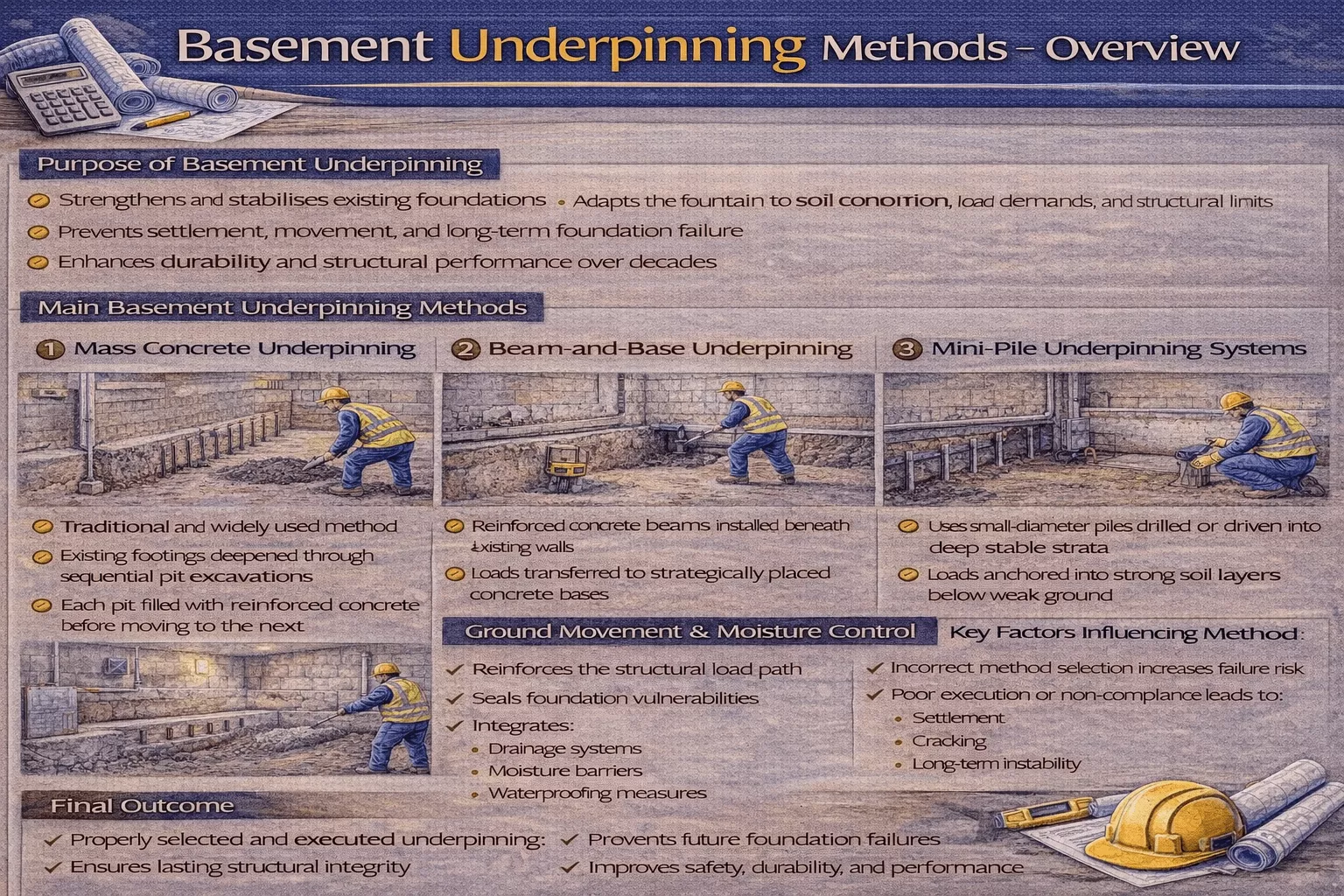
Basement underpinning employs several methods tailored to soil type, building condition, and project scope. Each technique serves a specific purpose, whether for shallow foundation reinforcement, deep excavation support, or stabilization in complex soil environments. The chosen method depends on structural load, accessibility, and local ground behaviour, all critical to ensuring long-term stability and compliance with Canadian building standards.
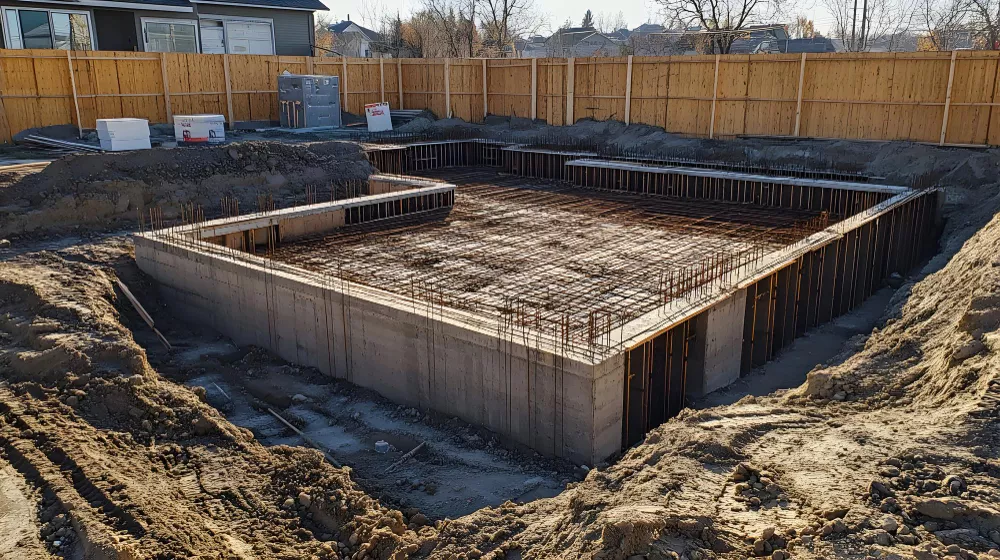
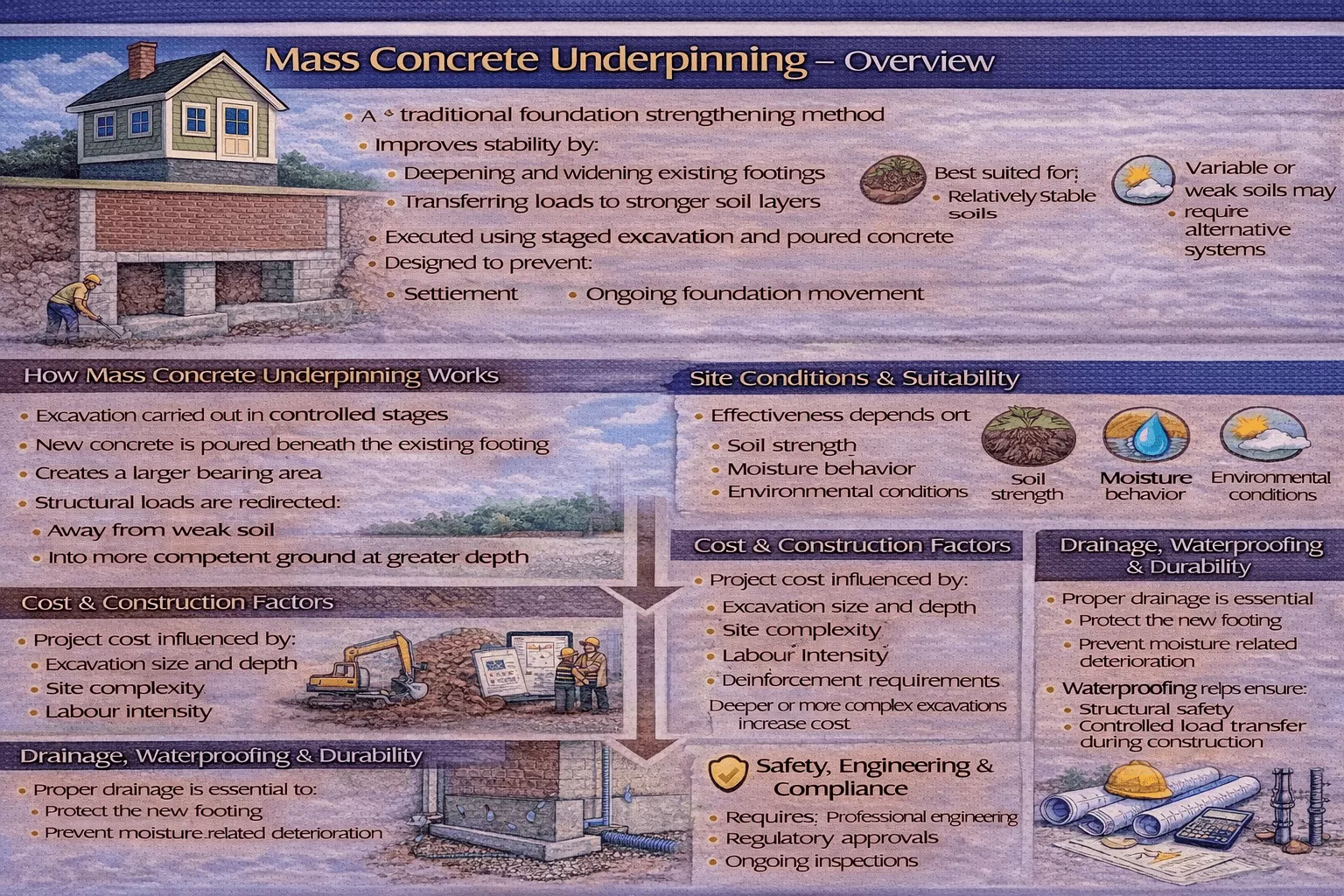
Mass Concrete Underpinning is the traditional technique best suited for shallow basements and stable soils. Contractors excavate beneath existing footings in small, sequential sections and fill each with concrete. Once cured, the process transfers the structural load gradually to the new, deeper foundation level. This approach is economical and reliable for older residential buildings requiring moderate foundation strengthening without heavy machinery.
Beam and Base Underpinning provides a more advanced system of reinforced structural load transfer. Engineers install reinforced concrete or steel beams beneath existing walls, supported by concrete bases at designated intervals. This design spreads the weight evenly and allows controlled load redistribution, making it ideal for buildings with uneven settlement or where structural adjustments are needed during renovation or extension work.
Mini-Piled Underpinning, also known as pier or micropile underpinning, is used for deep basements or projects in confined urban spaces. Small-diameter piles are drilled or driven to stable strata or bedrock, providing vertical support where soil conditions are weak or variable. This method minimizes vibration, allowing safe execution near neighbouring structures.
Chemical or Jet Grouting is preferred for urban projects and sandy or granular soils. It involves injecting high-pressure grout into the ground to form a dense, solidified mass beneath the foundation. This technique increases soil strength and prevents water ingress, offering precise control in limited-access environments where traditional excavation is impractical.
Together, these underpinning methods provide flexible, site-specific solutions for stabilizing, deepening, and upgrading foundations across varied Canadian construction conditions.
Basement Underpinning Process
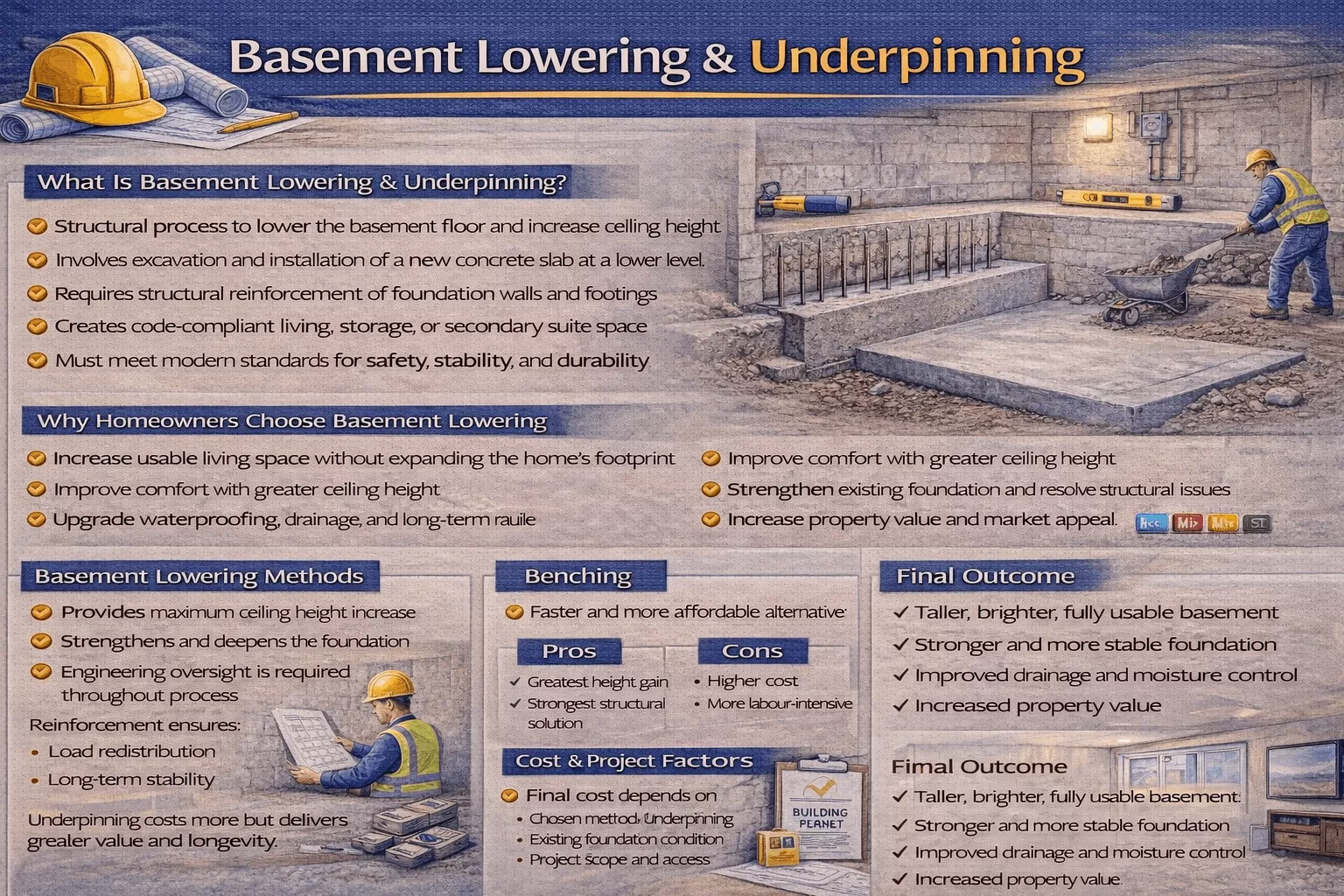
The basement underpinning process, also known in Canada as basement lowering or foundation strengthening, is a systematic structural procedure designed to extend the foundation to a deeper level and improve load-bearing capacity. The technique increases basement height, enhances usable space, and reinforces the foundation to meet modern load requirements. In Canada, this process follows strict engineering and safety standards to ensure stability during and after construction.
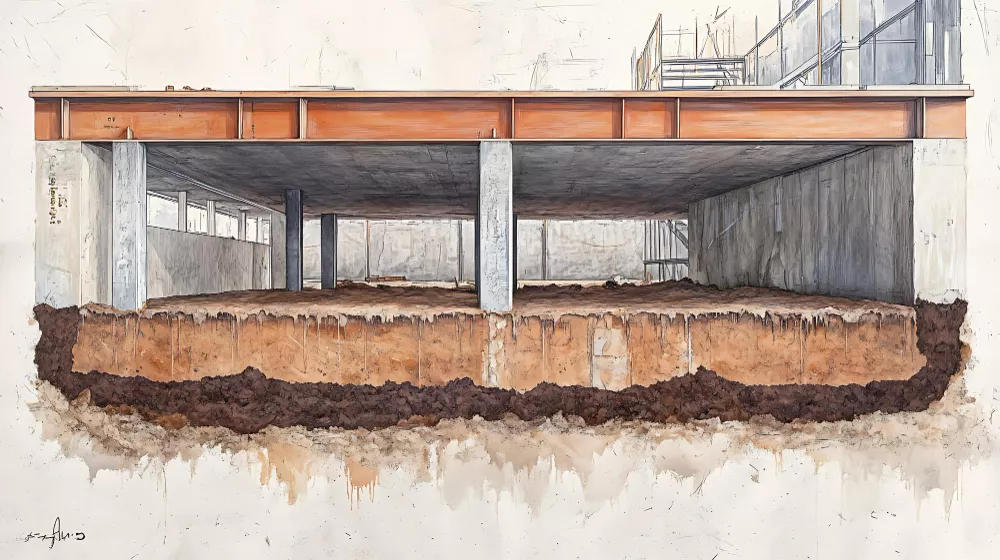
The process begins with a site survey and soil testing to assess bearing capacity, groundwater level, and soil composition. These findings guide the engineering design and calculations, which define excavation depth, underpin dimensions, and reinforcement details. Engineers prepare precise load-transfer models to ensure the new foundation safely supports both existing and future structural demands.
Excavation proceeds in staged sequences, known as bays or pins, to maintain structural balance. Each section is carefully dug, shored, and reinforced before moving to the next. Once exposed, the underpinning installation begins, using techniques such as mass concrete, beam and base, or resin injection, depending on soil type and design specifications. Each completed bay becomes a stable support point for the next stage of excavation.
Key structural control measures include:
- Continuous safety monitoring for settlement, cracking, or movement.
- Load testing and inspections after concrete curing.
- Compliance verification with local building and geotechnical standards.
This controlled process ensures the foundation remains stable while transforming older, low-ceiling basements into safe, full-height, and valuable living spaces.
Basement Underpinning Costs
Basement underpinning costs in Canada vary by method, soil condition, and project scale, typically ranging from $85 to $500 per sq. ft. The process strengthens and lowers existing foundations to create safe, livable basement spaces. For small homes, total project costs often range from $10,000 to $25,000, while larger or complex projects average $35,000–$100,000+, depending on engineering design, access, and soil stability.
Costs differ significantly by underpinning technique and site factors. Mass concrete is the most affordable, while mini-piled underpinning requires advanced equipment and deeper excavation, driving higher prices. Soil quality, groundwater, building age, and urban accessibility strongly influence overall expenditure.
| Aspect | Description | Typical Cost (CAD) |
|---|---|---|
| Mass Concrete Underpinning | Traditional method for shallow, stable soils. | $85 – $250 / sq. ft. |
| Beam & Base Underpinning | Reinforced load-transfer system for uneven settlement. | $200 – $350 / sq. ft. |
| Mini-Piled Underpinning | Deep, drilled supports for weak or variable ground. | $350 – $500 + / sq. ft. |
| Key Cost Factors | Soil condition, building age, access limits, and excavation depth. | — |
| Underpinning vs. New Build | 30–50% lower cost than full rebuild; new builds can reach $600–$800 / sq. ft. | — |
Underpinning remains a cost-efficient alternative to rebuilding, offering structural reinforcement and added basement space without full demolition, ideal for older Canadian homes seeking modernization and long-term stability.
Soil and Ground Conditions
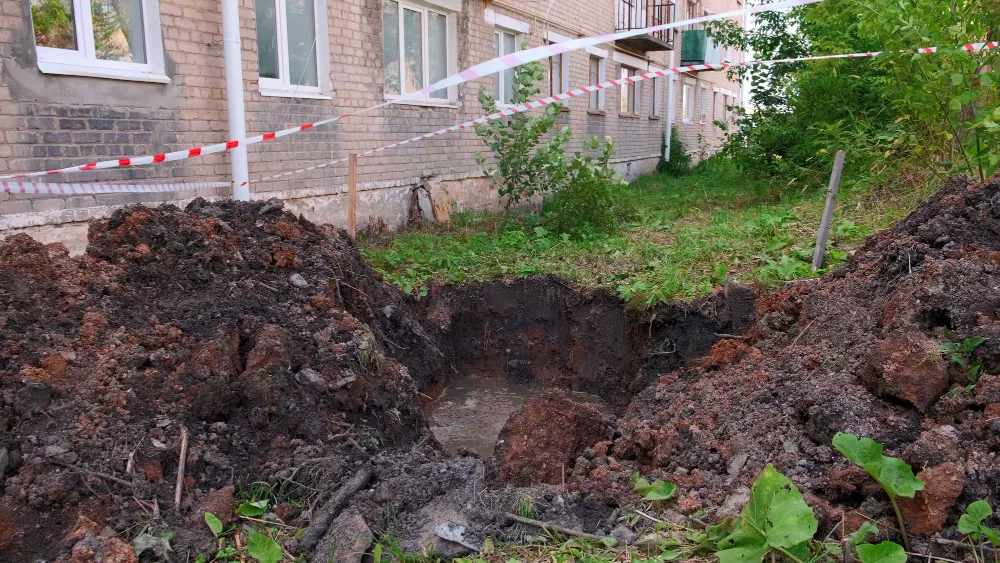
Soil and ground conditions are decisive in the success and longevity of basement underpinning across Canada. Each soil type behaves differently under load, moisture, and excavation stress, influencing both the design and safety of the foundation. Accurate site testing allows engineers to match the underpinning method and drainage design to soil performance, ensuring long-term structural stability.
Key considerations by soil type include:
- Clay Soils: Prone to expansion and shrinkage with moisture change. Engineers apply anti-heave precautions such as compressible void formers, drainage layers, and isolation barriers to prevent uplift pressure on foundations.
- Sandy Soils: Highly permeable but weak in cohesion. Chemical or jet grouting is used to bind particles, reduce collapse risk during excavation, and create a stable base for underpinning.
- Problem (P-Class) Soils: Includes reactive clays, organic matter, and uncontrolled fill. These require reinforced concrete piers, mini-piles, or deep stabilization to transfer loads to firm strata and bypass unstable layers.
Proper soil analysis and tailored reinforcement ensure that underpinning projects remain structurally sound, moisture-controlled, and fully compliant with Canadian geotechnical safety standards.
Causes Requiring Basement Underpinning
Basement underpinning is required when the existing foundation can no longer safely support the structure or when additional depth or load capacity is needed. It strengthens the foundation to prevent further movement, stabilize weak soils, and prepare the structure for future expansion. Each cause is evaluated through engineering assessment and soil testing to ensure compliance with Canadian structural and safety standards.
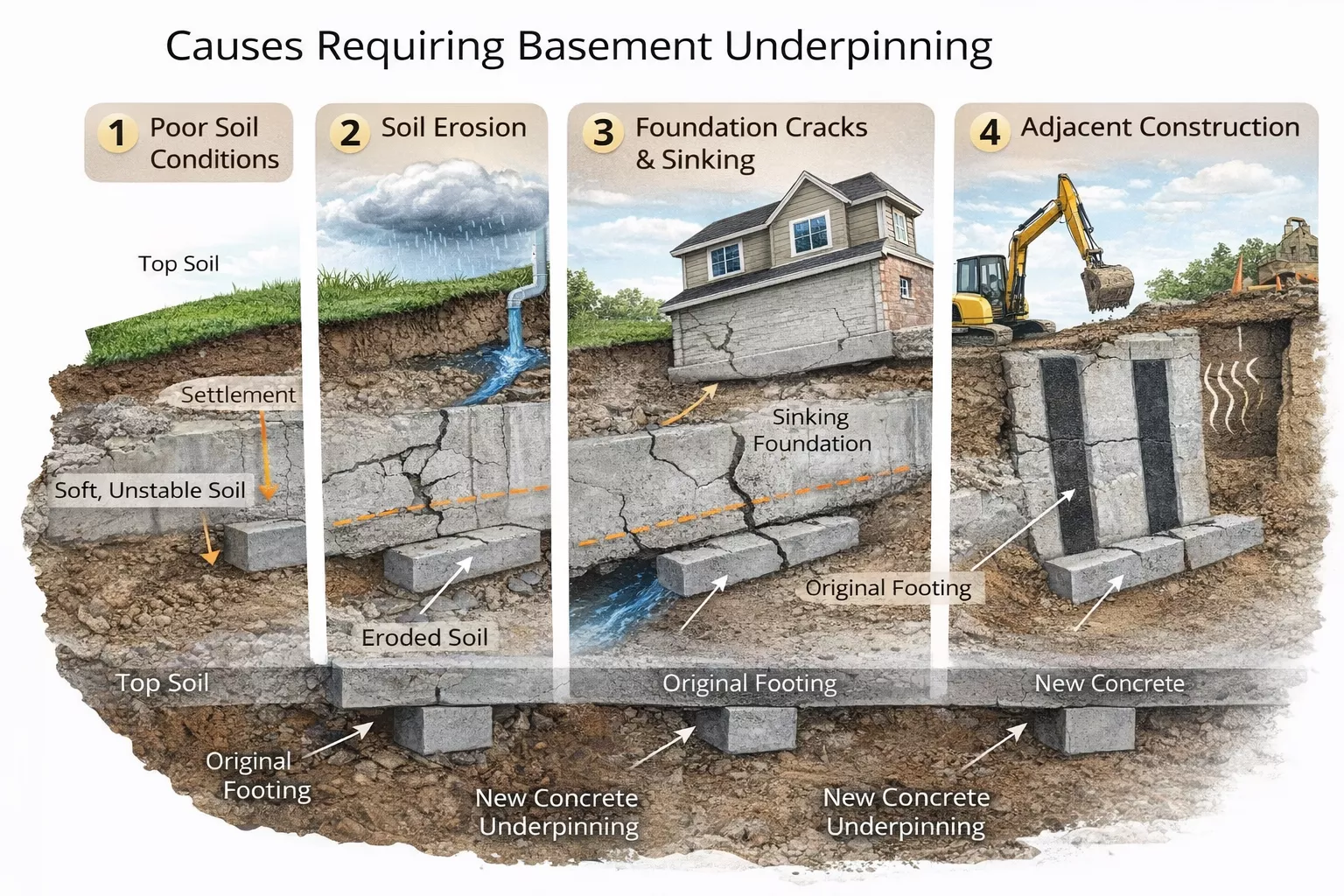
Common causes include:
- Subsidence and Settlement: Long-term soil compression, moisture loss, or poor original compaction can cause uneven sinking or cracking. Underpinning restores level support and redistributes structural loads evenly across stable strata.
- Foundation Instability from Nearby Excavation: Construction or deep excavation close to existing buildings can disturb soil pressure and weaken adjacent foundations. Underpinning stabilizes the affected structure, preventing lateral displacement or collapse.
- Adding New Storeys or Deepening Basements: When a homeowner plans vertical expansion or a deeper basement conversion, the existing foundation may not have the required load capacity. Underpinning strengthens and extends it to accommodate the increased weight and depth.
- Natural Disasters (Earthquake, Flood): Seismic movement, erosion, or groundwater saturation can reduce bearing strength or wash out support layers. Underpinning reinforces the foundation, restores structural integrity, and ensures resilience against future environmental stress.
By addressing these structural and environmental factors, underpinning maintains long-term foundation safety and extends the building’s service life under Canadian climatic and geotechnical conditions.
Basement Underpinning vs Alternatives
Basement underpinning and its alternatives, such as foundation replacement, retrofitting, or basement lowering, serve distinct roles in strengthening and expanding structural foundations across Canada. The most extensive option, foundation replacement, involves temporarily supporting the structure, demolishing the old foundation, and constructing a new one. It restores full structural integrity and allows full-height basements, but is highly disruptive and costly. This method is chosen when foundations are severely deteriorated, unsafe, or unsuitable for underpinning, ensuring a complete renewal of structural performance.
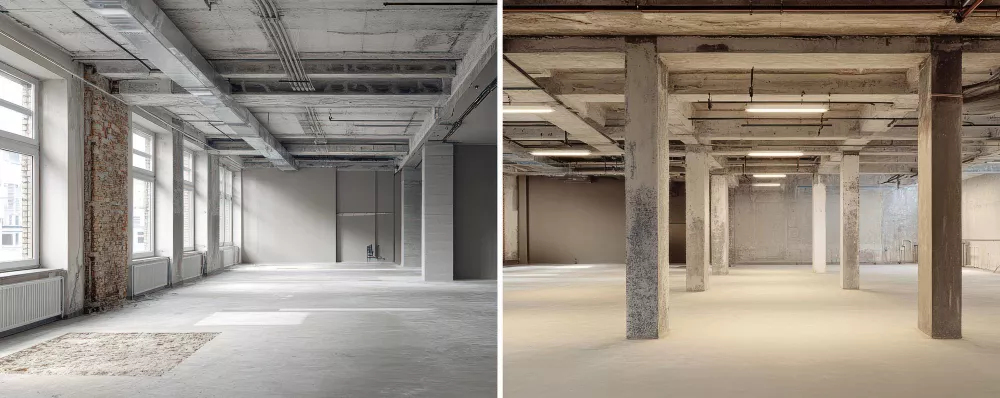
When assessing improvement approaches, engineers compare new build and retrofitting strategies based on construction scope, cost, and design flexibility:
| Aspect | New Build | Retrofitting (Underpinning/Benching) |
|---|---|---|
| Foundation Type | Built from scratch with modern load capacity | Strengthened existing foundation |
| Structural Integrity | Fully integrated design | Dependent on existing foundation strength |
| Cost & Duration | Higher cost, longer timeline | Lower cost, shorter duration |
| Flexibility | Unlimited design options | Constrained by existing structure |
| Ideal For | New construction projects | Renovations and basement upgrades |
Basement height and usability improvements are often achieved through basement lowering or underpinning, both enhancing functionality but differing in depth, scope, and results:
| Aspect | Basement Lowering (Benching) | Underpinning |
|---|---|---|
| Process | Excavates around perimeter, forming internal concrete bench | Excavates beneath footing to create deeper foundation |
| Usable Space | Slightly reduced floor area | Full expansion of basement footprint |
| Cost | Lower | Higher |
| Timeframe | Faster | Longer |
| Structural Strength | Minimal increase | Significant reinforcement and stability |
Foundation replacement ensures full renewal, retrofitting offers a balanced solution for existing homes, and underpinning provides the deepest, strongest, and most space-efficient outcome, making it the preferred choice for long-term basement improvement under Canadian construction standards.