What is basement lowering and how does it work?
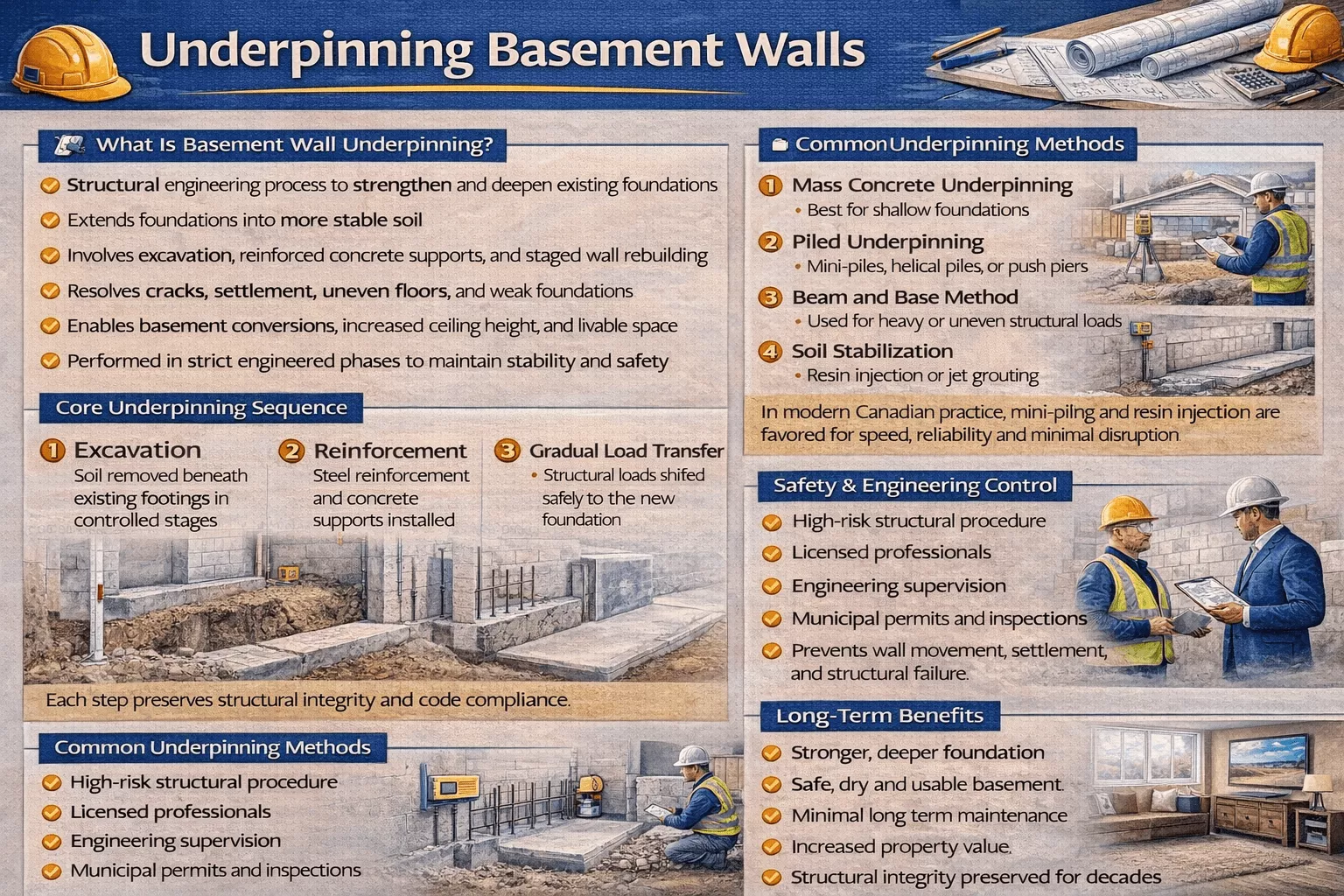
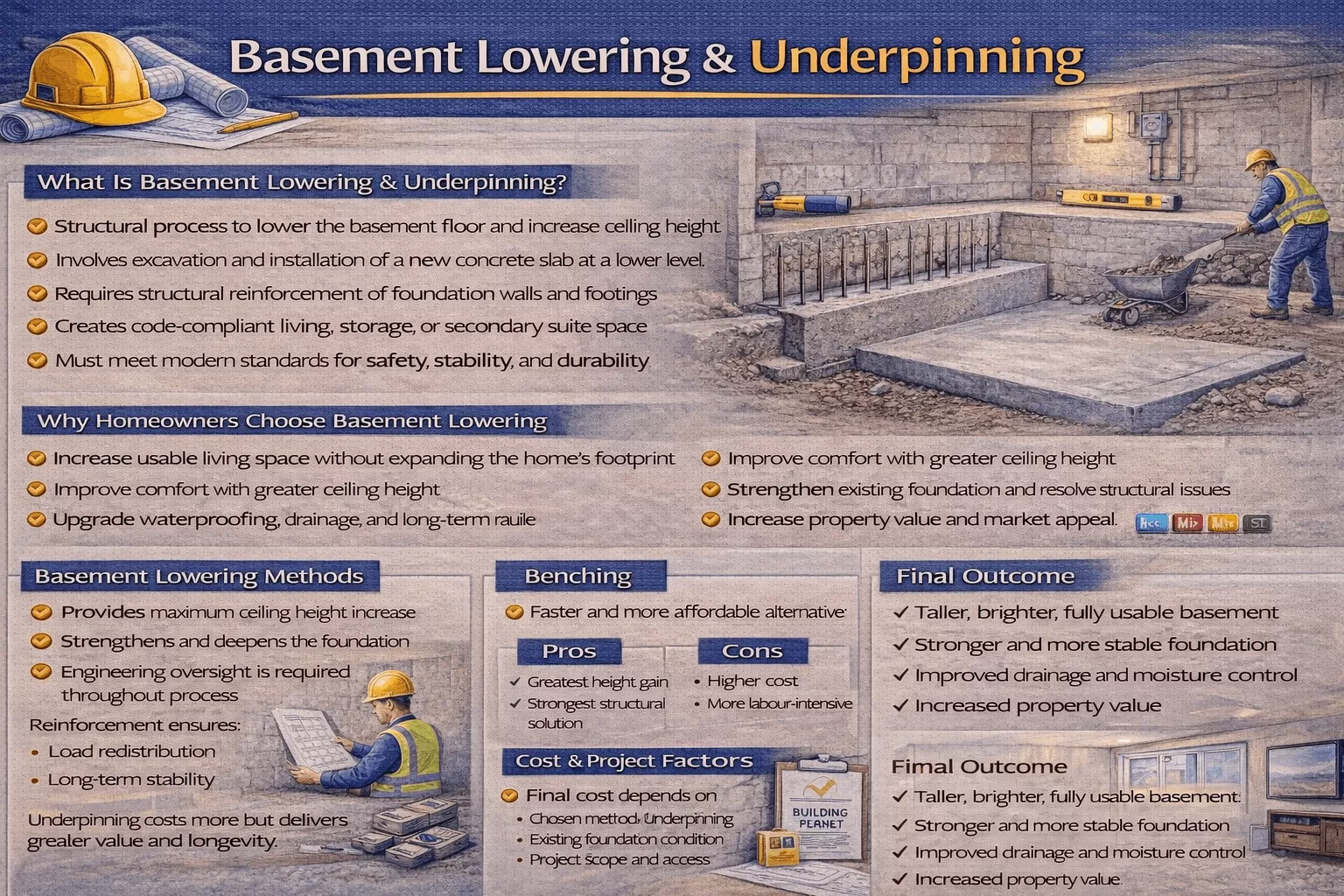
Basement lowering is a major structural renovation that involves excavating the existing basement floor and pouring a new concrete slab at a deeper level to increase ceiling height and usable space. This method transforms low or unfinished basements, often built as crawl spaces or basic storage areas, into functional, comfortable, and code-compliant living spaces that can increase a home’s value.
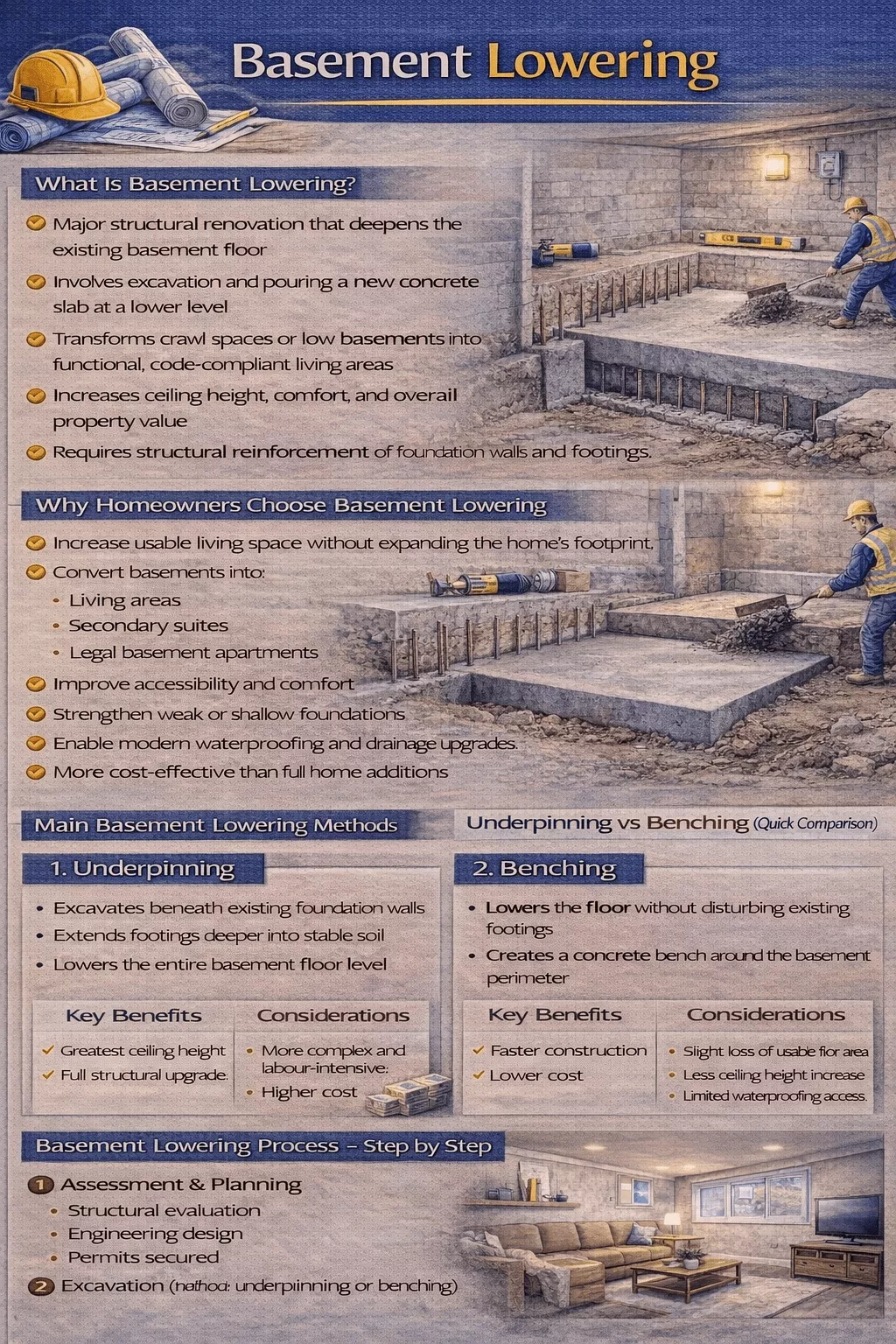
The process requires structural modification to the foundation walls and footings to reinforce the base and support the new lower level. This approach provides additional living space and allows for effective basement waterproofing.
The two main techniques for lowering a basement floor are:
- Underpinning
- Benching
What does the term “basement lowering” mean in building-renovation contexts?
In building renovation, the term “basement lowering” refers to the process, often completed through underpinning, of deepening an existing basement floor. This work is primarily done to increase ceiling height and create additional livable space, such as secondary suites or legal basement apartments, without expanding the home’s exterior footprint. Beyond adding space, basement lowering strengthens weak or shallow foundations, improves accessibility and comfort, and increases property value at a lower cost than traditional home additions.
What are the main structural methods used to lower a basement (underpinning vs benching)?
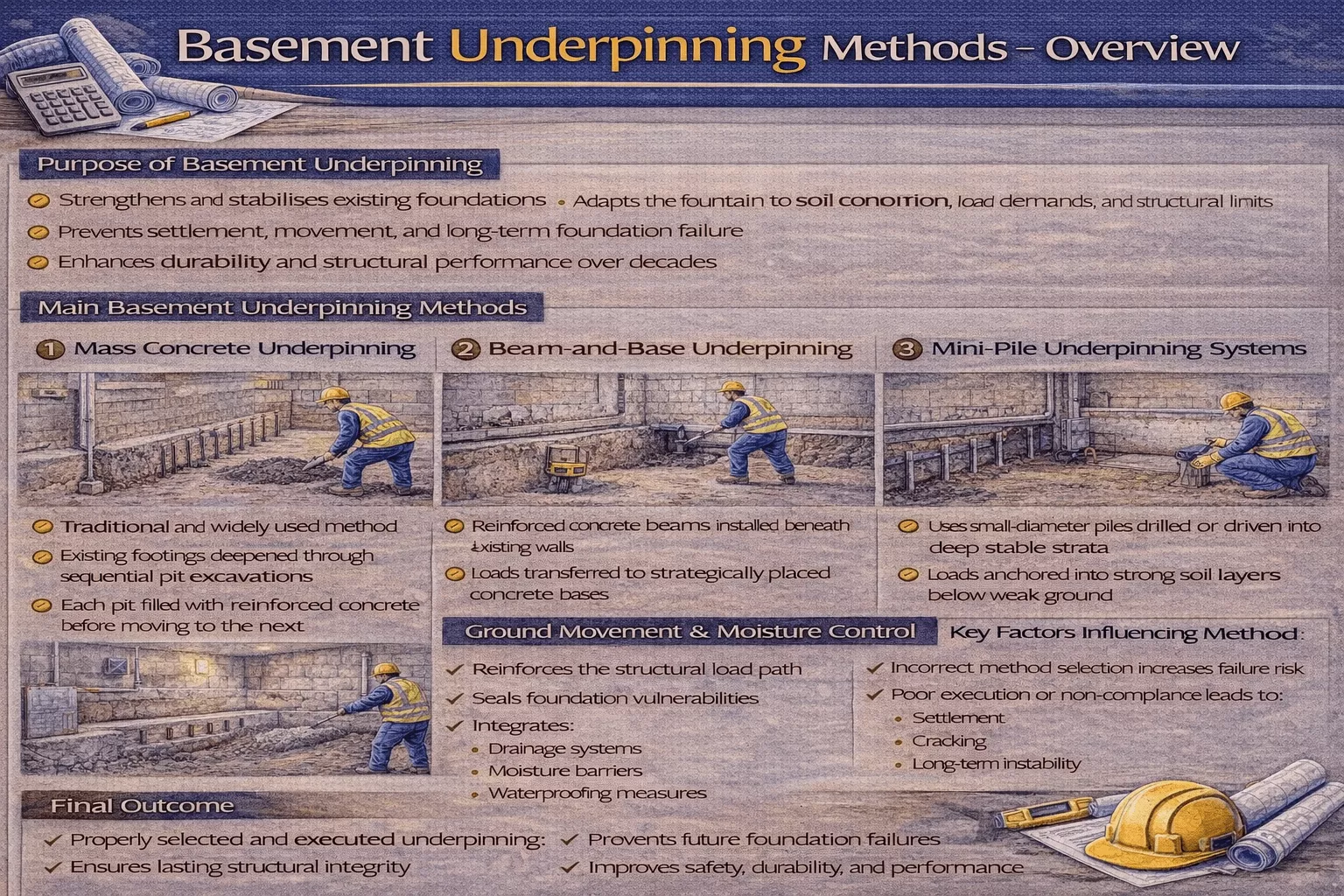
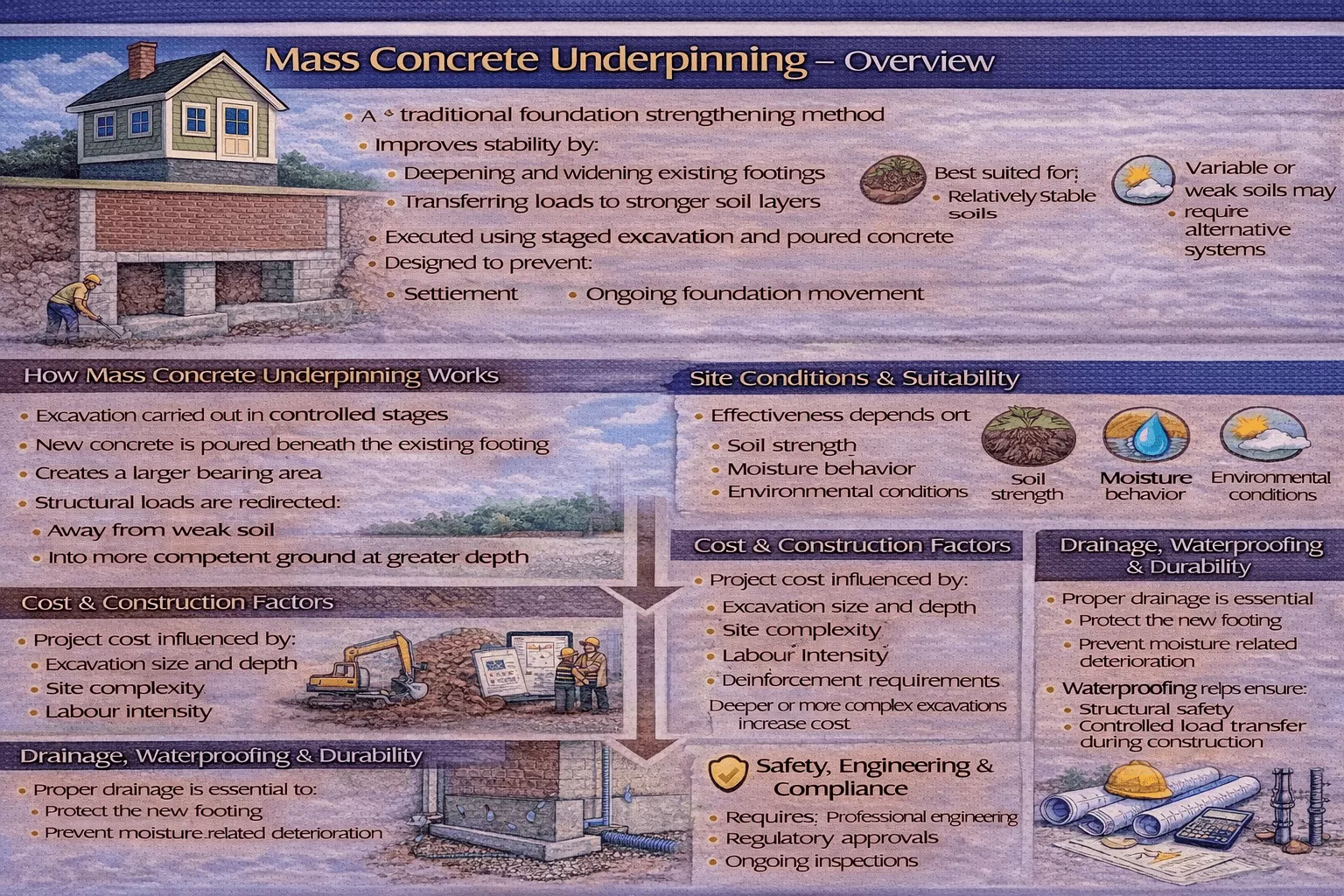
The two main structural methods used for basement lowering are underpinning and benching. Underpinning involves excavating beneath the existing foundation walls to extend the footings deeper, effectively lowering the entire foundation. Benching, on the other hand, lowers the floor without disturbing the current footings, creating a concrete bench-like ledge around the interior perimeter of the basement.
Both methods aim to increase ceiling height, add usable living space, and strengthen the existing foundation. Each requires detailed planning and must be carried out by qualified professionals.
Common objectives and requirements for both techniques include:
| Aspect | Underpinning | Benching |
|---|---|---|
| Foundation Adjustment | Extends existing footings deeper | Keeps existing footings intact |
| Ceiling Height Gain | Greater, full structural depth | Moderate, limited by bench height |
| Structural Complexity | High — requires staged excavation | Lower — minimal wall disturbance |
| Space Efficiency | Retains full floor area | Slight floor area reduction |
| Cost Range (CA) | Higher — labour-intensive | Lower — faster and less invasive |
| Waterproofing Opportunity | Excellent, full access to the foundation | Moderate, limited around the bench |
| Best For | Full-height conversions, structural upgrades | Budget-conscious renovations or partial height increases |
How does the basement lowering process proceed from assessment to the final floor?
The basement lowering process, often completed through a complex structural technique such as underpinning, increases ceiling height and converts unusable space into code-compliant living areas. It follows a series of carefully planned stages, from the initial structural assessment to the final floor installation.
- Assessment and Planning: The process begins with a structural evaluation of the existing foundation to design a suitable plan. Required permits are secured, and the appropriate method, underpinning (excavating beneath the foundation and pouring new concrete in stages) or bench footing, is selected.
- Excavation and Structural Reinforcement: The existing basement floor is excavated, and reinforcement work is carried out. When underpinning is used, new concrete footings are poured beneath the existing foundation in controlled sections to lower the floor level while maintaining structural stability.
- Base Preparation: After the main structural work, the floor level is further lowered, and the sub-base is prepared for the new concrete slab.
- Critical Systems Installation: Before pouring the final slab, key systems such as waterproofing, insulation, and ventilation are installed to ensure the basement’s long-term durability and comfort.
New Flooring and Final Finishing: The process ends with the pouring of the new slab, installation of utilities, and completion of interior finishes to create a safe, functional living space.
Why should a homeowner consider basement lowering?
A homeowner should consider basement lowering (also known as underpinning) because it is a highly beneficial renovation method and an excellent investment for those looking to transform an underused space. This technique, essential for foundation and space improvements, allows homeowners to enhance, strengthen, expand, and add value to their property without relocating.
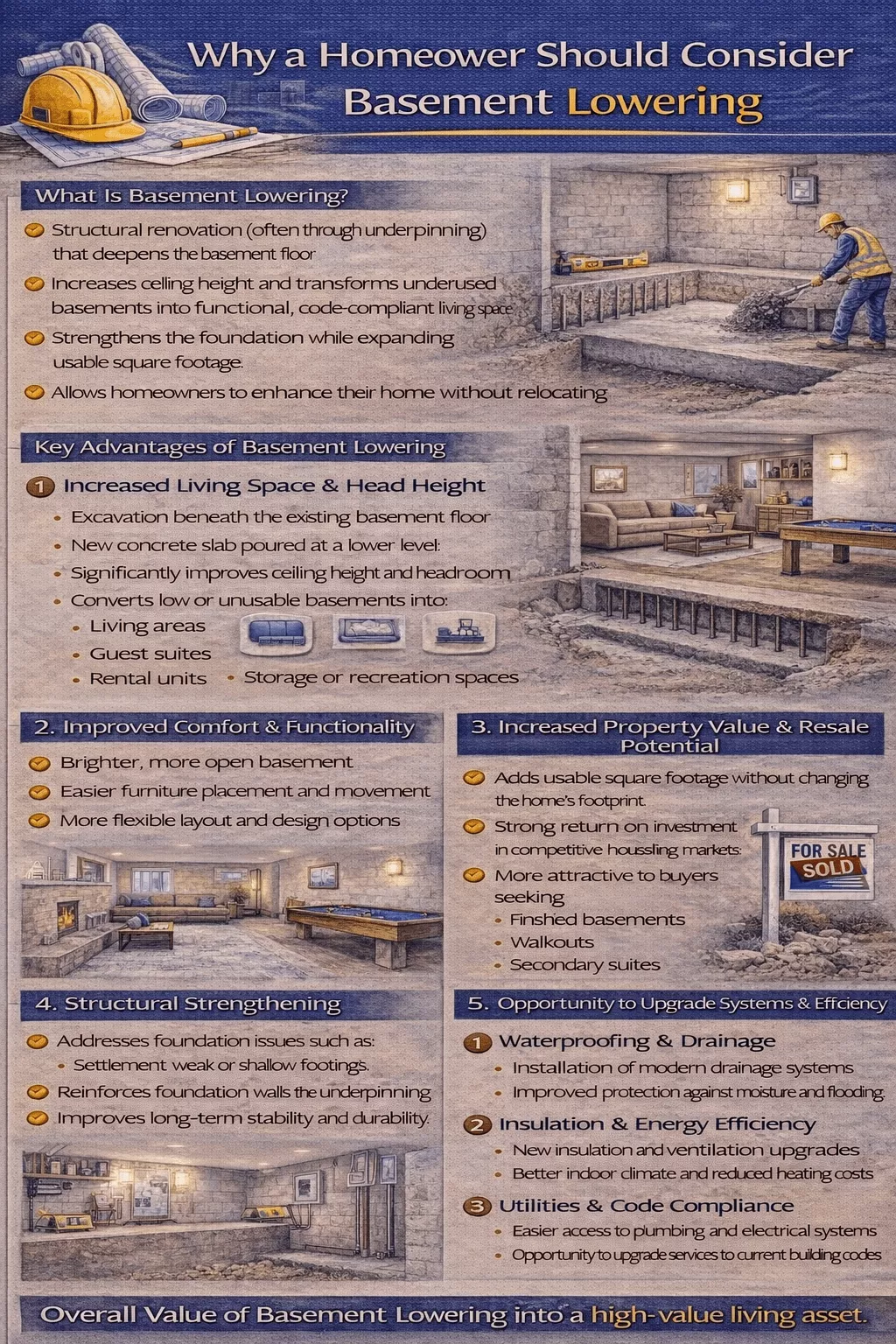
The key advantages of basement lowering include:
- Gaining valuable additional living space by significantly improving ceiling height and overall functionality, transforming the basement into a dynamic and usable part of the home.
- Increasing comfort, property value, and market appeal make the project a strong and worthwhile investment.
- Addressing and strengthening structural issues related to the home’s foundation.
How does basement lowering increase usable living space and head height?
Basement lowering increases usable living space and head height by structurally renovating the area, a technique sometimes known as underpinning. The process involves excavating beneath the existing basement floor and pouring a new concrete slab at a deeper level, effectively increasing the ceiling height and overall headroom. This structural change allows homeowners to transform previously low, unusable basements into comfortable, code-compliant living spaces. This process requires underpinning the foundation to maintain structural stability, often followed by reinforcing the walls and waterproofing the area.
How does basement lowering affect property value and resale potential?
The transformative process of basement lowering significantly affects property value and resale potential by increasing the height, functionality, and overall usable square footage of the property. This upgrade is considered a valuable investment that adds significant value and boosts the overall market value of the home. The resulting larger, more functional basement, especially when paired with features like a walkout, appeals strongly to potential buyers, making the property more desirable in high-demand or competitive housing markets and thus maximizing its resale potential. This added functionality also creates opportunities for additional rental income or provides a more comfortable living space or room for storage, further increasing the property’s overall appeal and marketability.
How does basement lowering offer an opportunity to upgrade insulation, waterproofing and services?
Basement lowering offers an opportunity to upgrade insulation, waterproofing, and services because the required structural work exposes crucial parts of the foundation and internal systems, allowing for comprehensive improvements:
- Waterproofing and Drainage: New drainage systems and waterproofing measures are installed during the process, specifically designed to prevent water infiltration, moisture, and flooding, protecting the structural elements of the foundation.
- Insulation and Energy Efficiency: The work allows for the addition of heat insulation and updates to the ventilation system. This improves the indoor climate, strengthens structural integrity, and reduces heating costs, contributing to improved energy efficiency and property value.
Internal Services and Code Compliance: The underpinning work provides access to the internal systems of the home, such as electrical wiring and plumbing. This opportunity allows for a thorough inspection and easy updates, ensuring these services meet current code standards.
How much does basement lowering cost?
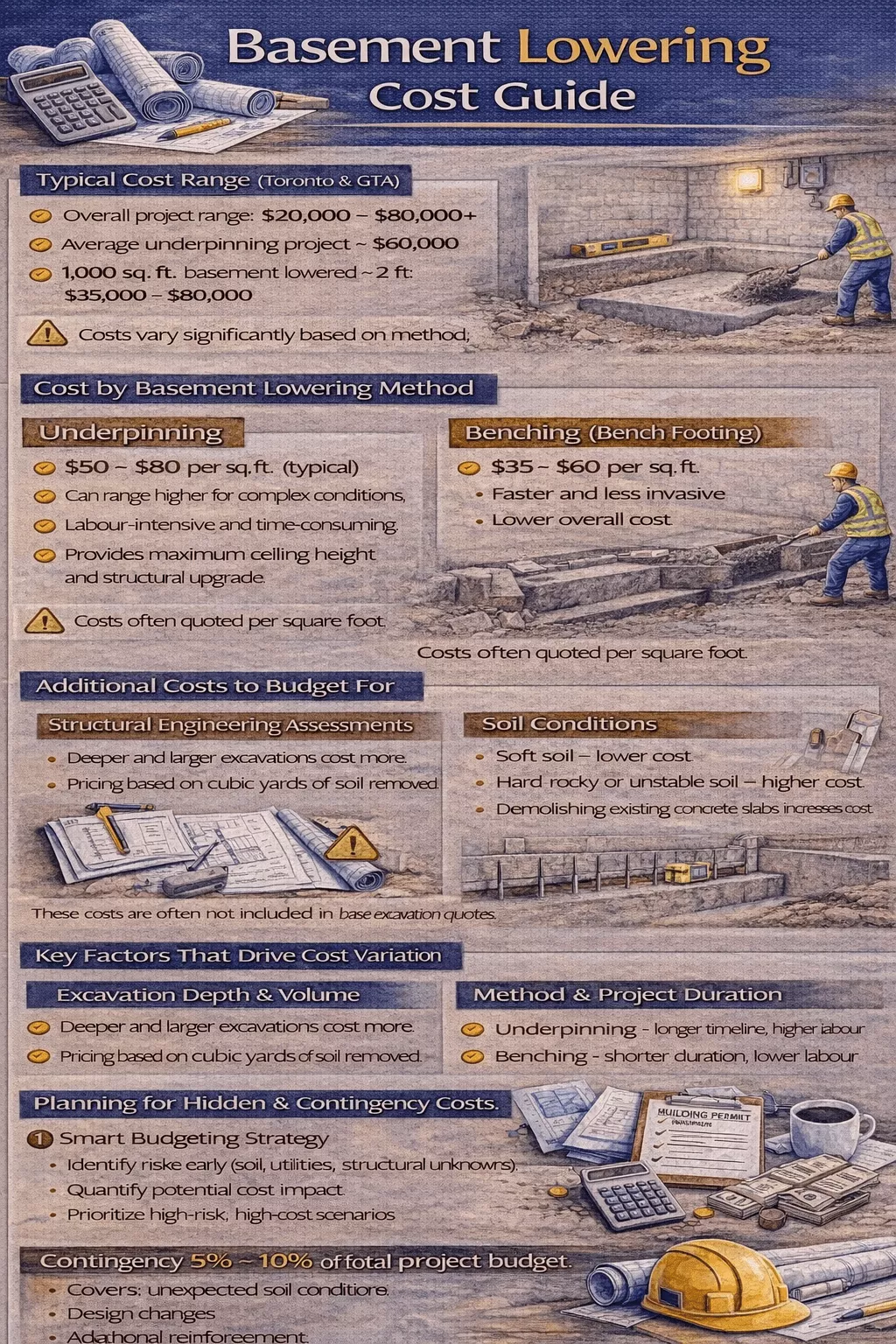
The cost of basement lowering typically ranges widely based on the method used, project scope, and specific property conditions. For homeowners, particularly in the Toronto area, total project costs generally range from $20,000 to $80,000, with many average underpinning projects costing around $60,000. For example, lowering a standard 1,000-square-foot basement by two feet can range between $35,000 and $80,000. This complex, labour-intensive process involves extensive excavation and underpinning to increase ceiling height and improve usability, and costs are often quoted per square foot depending on the technique chosen: underpinning typically ranges from $50 to $80 per square foot, and bench footing costs $35 to $60 per square foot. Homeowners must also budget for additional expenses such as permits, engineering assessments, waterproofing, and finishing work.
What are the typical cost ranges for basement lowering projects?
The typical cost ranges for basement lowering projects, which are complex and labour-intensive processes often involving extensive excavation and underpinning to increase ceiling height, vary significantly based on the method chosen and specific property conditions.
When viewed on a per-project basis (particularly in the Toronto area), costs generally range from $20,000 up to $100,000 or more. For a standard 1,000-square-foot basement being lowered, homeowners typically expect to pay between $35,000 and $80,000. Costs calculated per square foot depend heavily on the method employed: underpinning costs can range broadly from $50 to $450 per square foot, while bench footing typically runs $35 to $60 per square foot. These figures exclude additional costs that apply for permits, engineering assessments, waterproofing, and finishing work.
Which factors drive cost variation (excavation depth, soil conditions, access, method)?
The factors that drive cost variation in excavation are primarily related to the scope, volume, complexity, and site conditions of the project, often leading to variations ranging from $100 per hour for a small job to over $500 per hour for larger projects.
Key factors influencing the final price include:
- Excavation Depth and Size (Volume): Excavation cost is priced per the volume in cubic yards of dirt removed. Larger and deeper holes, such as those required for foundations or pools (compared to smaller projects like French drains), result in significantly higher costs due to increased machine time and the need for greater soil and material removal.
- Soil Conditions and Characteristics: The type of soil affects the complexity of the process and the final price. Soft ground is easier to dig, while soil that is hard, stony, or otherwise complex will make the excavation process more difficult. Costs may further rise if the excavation company has to demolish a concrete slab or other solid structure.
- Site Accessibility: Projects located in difficult-to-reach areas incur higher costs than those that are easily accessible.
- Project Scope and Duration (Method): The overall size of the job determines whether it is priced as a small project or a large one, with costs directly correlating to the total machine time required for completion.
How can you budget and plan for hidden or contingency costs in a lowering project?
The way you can budget and plan for hidden or contingency costs in a project involves a systematic approach centred on risk assessment and ongoing monitoring:
- Assess project risks, uncertainty, and risk exposure, often involving collaboration with the project team, development team, and the PMCoE. Quantify the financial impact of these risks and use supporting documentation, such as the project cost estimate, risk register, and Monte Carlo analysis, to determine risk exposure.
- Prioritize the quantified risks based on their expected costs. Allocate funds to cover the most likely and expensive contingencies first, assigning the remaining funds to cover lesser events and risks.
- Calculate the contingency reserve based on a preferred method, ensuring the amount is well researched and defensible. This total contingency request, which combines estimate contingency and risk contingency, typically falls between 5% and 10% of the overall project budget.
- Set aside the determined contingency amount, ensuring that the allocation is neither excessive nor insufficient, as both can have negative consequences for the project.
- Regularly review and monitor the budget to address any emerging risks and necessary adjustments throughout the project lifecycle.
How do you choose the right method for basement lowering?
The process of choosing the right method for basement lowering depends on several key factors, which primarily differentiate between underpinning (full basement lowering) and benching (bench footings).
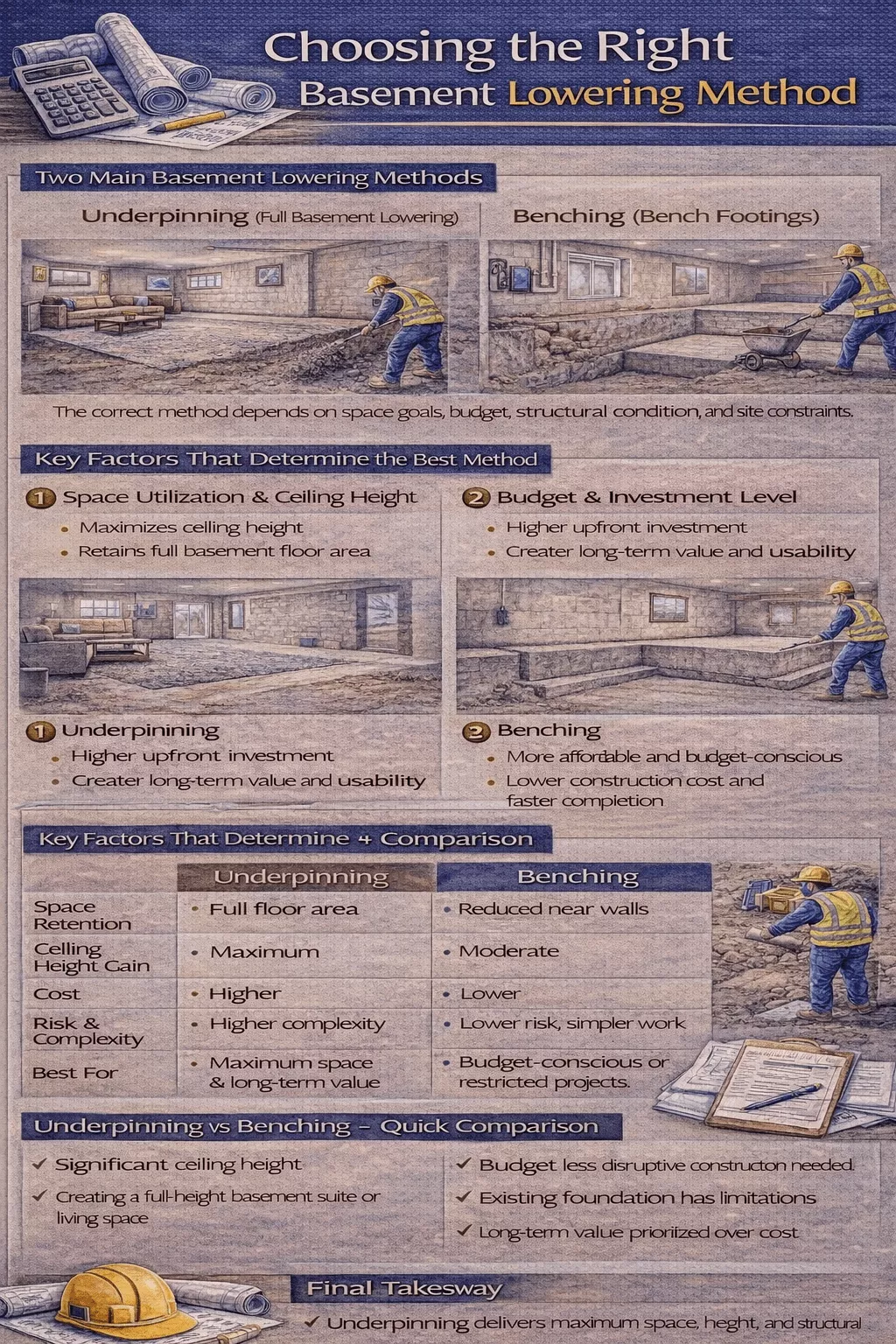
The methods are selected based on the following criteria:
- Space Utilization and Height: Underpinning is ideal when prioritizing maximum usable basement space and ceiling height, as bench footings sacrifice some floor area and width due to the creation of the bench around the perimeter.
- Budget and Investment: Bench footings (benching) are the more affordable and budget-conscious option. Full underpinning is a bigger investment that offers significant long-term benefits in terms of space.
- Structural Needs and Foundation Stability: If the foundation needs reinforcement or if you require maximum stability, full underpinning is the preferred and best choice. Benching is often considered a lower-risk route for homes with existing structural limitations, provided maximum depth is not strictly necessary.
- Professional Assessment: Regardless of initial preference, a qualified contractor must assess the stability of your foundation and property to recommend the safest and most cost-effective approach.
What are the advantages and disadvantages of underpinning vs benching?
Underpinning and benching both increase basement height and improve property value, but they differ in cost, space efficiency, and structural suitability. Underpinning involves extending the foundation downward, allowing full use of the basement’s floor area and offering the greatest height gain. Benching lowers the floor while leaving the existing footings intact, creating a perimeter ledge that reduces usable interior space but lowers cost and construction risk.
Choosing between the two depends on goals, budget, and the condition of the existing foundation. Underpinning is best for projects that prioritize maximum space and ceiling height, while benching suits homeowners seeking a more economical option or those with structural limitations that prevent full-depth excavation.
Comparison of the advantages and disadvantages of underpinning vs benching:
| Aspect | Underpinning | Benching |
|---|---|---|
| Space Retention | Keeps the full floor area | Reduces space due to the perimeter ledge |
| Ceiling Height Gain | Maximum height potential | Moderate height increase |
| Cost | Higher investment | More affordable |
| Risk Level | Higher structural complexity | Lower risk, simpler work |
| Foundation Requirements | Requires a stable foundation | Suitable for homes with limitations |
| Best For | Maximum space and long-term value | Budget-conscious or restricted projects |
In which situations is underpinning preferred and when is benching more appropriate?
Underpinning is the preferred method in situations requiring major structural improvements and maximum ceiling height, while benching (or bench footing) is more appropriate for budget-conscious projects seeking smaller spatial adjustments.
Underpinning is considered the go-to choice when prioritizing depth, space, and structural integrity, specifically in the following scenarios:
- Significantly increasing basement height (e.g., for a basement suite or extra living space) to maximize usable space.
- Reinforcing the existing foundation due to settlement, cracks, or structural issues, or when supporting heavy renovations or an added load to the home’s structure.
- The project demands the best results for maximizing structural integrity and is less concerned with the higher cost and disruption.
Conversely, benching (or bench footing) is a better, lower-risk fit when specific limitations or project goals are met:
- Budget is a primary concern, as it is a more budget-friendly and budget-conscious option.
- Only smaller height adjustments are needed, or the goal is to add some space without requiring the full depth provided by underpinning.
- The project requires a quicker and less disruptive process.
- There are minimal structural concerns, and the immediate need is simply to create more usable space.
What structural site-access or regulatory constraints influence method choice?
The structural site-access or regulatory constraints that influence method choice are varied and typically dictate the feasibility, safety, and cost of foundation repair or underpinning projects.
These constraints often determine whether specialized compact equipment, less intrusive methods, or traditional approaches are necessary:
- Limited Site Access and Equipment Limitations: Projects with limited access where traditional methods cannot accommodate site constraints often require the use of screw pile and bracket systems. This method is favoured because it provides effective underpinning using relatively compact equipment that can work efficiently in confined spaces.
- Weak Foundation or Unstable Soil Conditions: When dealing with weaker foundations or unstable soil conditions, particularly in older houses where full underpinning might pose structural risks, the benching (bench footing) approach is often the better choice. Benching puts less stress on existing foundation walls.
Regulatory and External Hurdles: Method selection must anticipate and conform to stringent local building codes, while also being prepared for potential complications such as unexpected hidden utility lines or unforeseen soil conditions, which influence the structural requirements and flow of the project.