
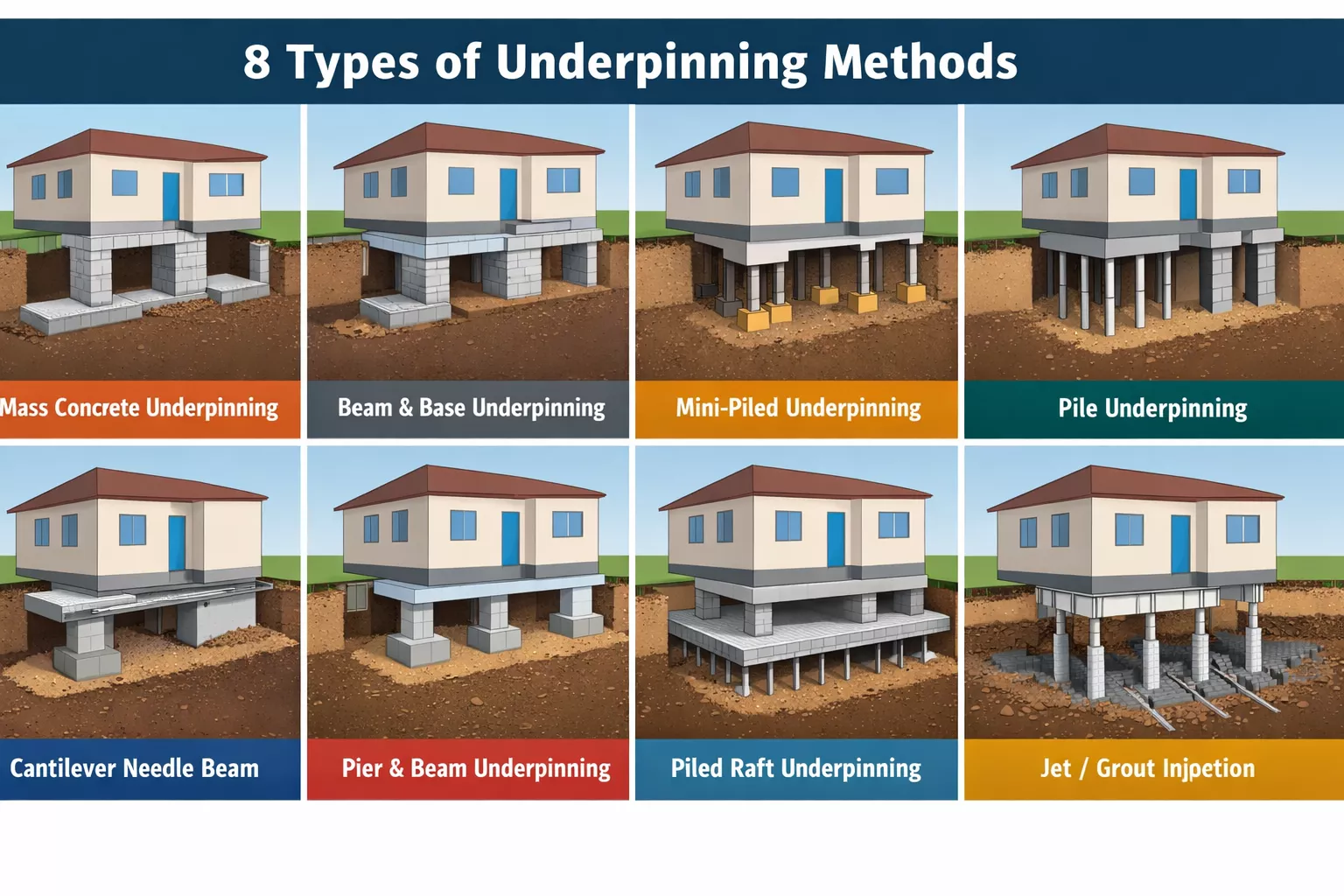
Underpinning is a fundamental construction process used to strengthen or stabilize the foundations of existing buildings. Whether addressing subsidence, heave or deteriorating ground conditions, there are several methods available each suited to different site conditions, depths and structural requirements. The eight main types include mass concrete (pit method), mini-piled, beam and base, piled raft, resin injection, jack pile, cantilever needle beam and pier and beam underpinning.
The most traditional approach is the mass concrete pit method, which involves excavating staggered rectangular pits beneath existing foundations and filling them with concrete to reach stable soil best suited for shallow foundations in relatively stable ground. Where deeper support is needed, mini-piled underpinning offers a more specialized solution, driving or augering small-diameter piles deep into competent subsoil layers, making it a popular choice for basements, large structures and buildings affected by subsidence or heave.
For more complex structural configurations, beam and base underpinning introduces a reinforced concrete beam to redistribute the building’s load onto mass concrete bases, with dimensions tailored to site-specific ground conditions. Taking this further, piled raft underpinning severs the building from its original foundation entirely, replacing it with an internal hybrid structure combining piles and a reinforced concrete raft particularly useful where conventional methods prove impractical or too costly for an entire building.
Among the more modern innovations, resin injection underpinning stands out for its minimal disruption, injecting an expanding resin directly through the foundation to fill voids, compress surrounding soil and lift the structure all without excavation and with a curing time of around 15 minutes. Similarly non-invasive, jack pile underpinning uses hydraulic jacks to drive steel pipes to bearing depth, offering a silent, vibration-free method where deep subsoil support is required, though the integrity of the existing foundation is critical to its success.
For sites where excavation is only possible in one direction, cantilever needle beam underpinning extends the principles of mass concrete underpinning by strapping a cantilever beam to compression and tension piles, effectively transferring load to stable strata without the need for internal column access. Finally, pier and beam underpinning addresses settlement in crawl space structures caused by age, moisture or pest damage, employing helical piers, screw jack systems and girder repairs to restore stability and prevent future deterioration.
Together, these eight methods reflect the broad range of engineering solutions available to address foundation failure, with the most appropriate choice depending on soil conditions, structural load, site access, and project budget.
1. Mass concrete (pit method) Underpinning
Mass concrete (pit method) is a traditional underpinning technique used to strengthen a building’s existing foundations by excavating small, rectangular pits beneath them in a staggered sequence. This reliable solution involves filling these excavated sections with concrete to form new footings that extend to a stable soil layer, often using needles to support the structural load during the curing process. It is considered most suitable for shallow foundations located in relatively stable soil conditions.2
2. Mini-piled Underpinning
Mini-piled underpinning is a specialized stabilization method that involves inserting small-diameter piles either augered or driven beneath an existing foundation to transfer the building’s load to stable subsoil layers at considerably greater depths than traditional mass concrete methods. Much like staking a young tree for stability, this process effectively shores up weak areas to prevent settlement and is a popular choice for countering structural problems such as subsidence or heave. It is frequently utilized for diverse projects ranging from the construction of large structures and home basements to the reinforcement of existing buildings where ground conditions require deep, reliable support.
3. Beam and base Underpinning
Beam and base underpinning is an advanced foundation repair method that involves constructing a reinforced concrete beam below, above or in place of the existing footing to transfer the structure’s weight to mass concrete bases. This technique is designed according to the building’s configuration, with the size and depth of the bases adjusted to suit specific ground conditions.
4. Piled raft Underpinning
Piled raft underpinning is a specialized technique that involves severing a building from its existing foundation to provide a new, internal hybrid structure designed to pick up and distribute the building’s load. This method integrates piles with a reinforced concrete raft to efficiently transfer superstructure loads onto competent strata, especially in cases where a conventional raft foundation cannot provide adequate support. Often used when traditional underpinning methods are not suitable or cost-effective for an entire building, piled raft underpinning offers the added benefit of a reduced project programme compared to more conventional techniques.
5. Resin injection Underpinning
Resin injection underpinning is a modern and innovative solution for stabilizing and lifting building foundations that serves as a faster, cleaner and more cost-effective alternative to traditional methods. The process involves injecting environmentally friendly resin through small holes in the foundation, where it flows into the soil to fill voids and cracks, then expands as it gels and cures to compress the surrounding soil and lift the structure back to its original position. This eliminates the need for excavation or digging underneath the building, making it much less invasive and time-consuming, while providing a rapid solution as the resin typically cures in about 15 minutes without requiring the building to be vacated.
6. Jack pile Underpinning
Jack pile underpinning is a structural stabilization method that uses small-diameter steel pipes or piers driven to a bearing depth by hydraulic jacks secured to an existing structure. This approach is often chosen as a cost-effective alternative to traditional underpinning when suitable bearing subsoil is located at significant depths. The process is characterized as being silent, vibration-free and adaptable, as pile depths can be adjusted to suit underlying soil conditions. Once the hydraulic jacks are removed, pile caps are cast directly onto the jack pile heads; however, because the existing structure provides the resistance for the jacks, the condition of the original foundations is critical to the success of the installation.
7. Cantilever needle beam Underpinning
Cantilever needle beam underpinning is an extension of mass concrete underpinning used to support structures with weak foundations when site limitations restrict excavation to a single direction. This technique involves strapping a cantilever beam to a system of compression and tension piles that rest on firmer soil strata deep underneath the building. By transferring the structural load from the weak foundation to these stable piles, this method prevents building collapse in situations where traditional deepening techniques or standard needle beams which typically require strapping to an existing interior column cannot be utilized.
8. Pier and beam Underpinning
Pier and beam underpinning is a specialized foundation repair process used to stabilize and support crawl space structures that have experienced settlement or damage due to age, water or wood-destroying insects. Common solutions and components include installing crawlspace and interior floor helical piers to provide deep structural support, using screw jack bracket systems to level and stabilize the foundation, repairing or completely replacing damaged girders and beams to restore structural integrity, conducting a professional assessment to identify the root cause of settlement and ensure repairs are implemented safely and providing ongoing maintenance with proper installation to prevent future damage and extend the life of the foundation.
How to Choose a Type of Underpinning Method?
Choosing a type of underpinning method involves assessing several critical factors to determine the most effective way to strengthen and stabilize a property’s foundation.
The key considerations for selecting the most appropriate underpinning solution include:
- The specific type of building and its structural requirements.
- Soil conditions and the likelihood of the ground sinking over time.
- The severity of any existing movement or damage to the foundation.
- The project budget and financial constraints.
- Future plans for the property, such as whether it will be expanded or reconstructed.
- Professional evaluation by an engineer to ensure the method chosen provides long-term quality and workmanship guarantees.
Climate
Climate affects property foundations through external factors and natural disasters that can cause a loss of original stability over time. The impact of climate-related conditions on foundations is detailed below:
- Natural disasters such as heavy rains, earthquakes and sinkholes that can lead to soil subsidence and ground movement.
- External environmental factors that require foundations to be built with high-quality materials, strength and durability.
- The use of underpinning methods to make buildings resistant to shifting ground and other climate-related stresses.
- Environmental conditions that contribute to soil subsidence, which is a primary reason foundations lose their structural integrity.
Budget
The budget for foundation underpinning projects typically ranges from $10,000 to $30,000 and homeowners can obtain a clear price and expert advice by getting an instant online estimate or requesting a callback from a specialist to start the stabilization process.
Maintenance Level
Maintenance level refers to the structural stability and long-term durability of a building’s foundation, which is preserved and restored through specialized underpinning techniques.
- Underpinning is used to maintain levels by extending foundations to a deeper, more secure soil substratum or by strengthening the ground itself to ensure the building is adequately supported.
- High-quality materials and precise methods are employed to provide the strength and durability needed to make buildings resistant to shifting soil and other external factors.
- Maintaining a structure’s integrity typically begins with a full assessment and can include extensive protection, such as a 100-year product guarantee and a 50-year workmanship guarantee.
- These stabilization techniques are essential for both older buildings with shallow foundations and modern structures that no longer receive sufficient support from the ground.
Durability and Longevity
The durability and longevity of underpinning solutions ensure that a home remains stable for the natural life of the structure, provided the work is expertly installed and no new environmental issues arise. Rather than being a temporary fix, properly implemented underpinning is a comprehensive solution designed to last for decades, often backed by long-term warranties of around ten years that reflect confidence in the work’s quality. It provides permanent support even when dealing with unstable soil or increased load-bearing requirements, such as the addition of new floors or spaces to a building.